
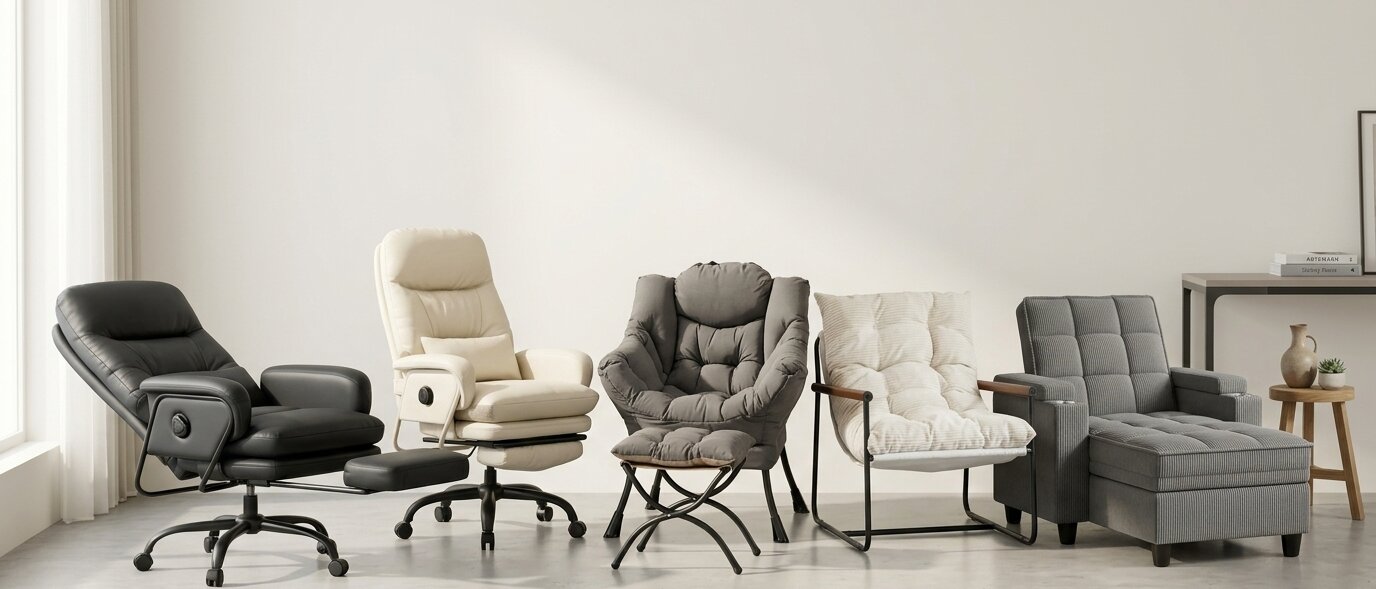
The ergonomics of a lounge chair is a topic most furniture brands would rather skip entirely. Call something “ergonomic” on a product page, put it next to a person sitting in a vaguely reclined position, and a lot of shoppers will move on satisfied. We don’t work that way.
Here’s the real problem most home setups face. You need a chair that supports focused work when you’re grinding through a two-hour session, and something genuinely comfortable when you’re recovering from it. A task chair handles the upright half reasonably well. The relaxation half — lumbar support in a reclined position, pelvic neutral through a chaise footrest, shoulder mechanics on an adjustable pillow — is where most loungers quietly fail their users.
We evaluated five lounge chairs currently listed on Amazon that all make some version of an ergonomic claim. Two are FLEXISPOT builds — a brand with real office chair credibility behind it — and the remaining three range from a compact accent chair with an ottoman to a full 41.7-inch oversized convertible. We tested each one through active mixed-use workdays, cross-checked structural mechanics against our knowledge of reclining posture science, and flagged every design limitation we found. Here’s what the listings don’t say.
The Brutal Reality of Budget Lounge Chair Ergonomics
Nobody designing a lounge chair for the sub-$300 market is going to publish its actual weaknesses, so we will. The phrase “ergonomic lounge chair” covers an enormous range of engineering quality, and the photographs rarely tell you which end of that range you’re actually looking at.
Start with the reclining mechanism. A 4-position lockable recline sounds robust on paper. In practice, the mechanical integrity of that lock depends almost entirely on the quality of the steel locking plate and the frame bracket it seats into. Cheap stamped steel in that assembly means the lock position feels slightly “soft” — not dangerous, but noticeable after a few months of repeated use. Premium-grade locking hardware holds crisp across hundreds of daily cycles. You generally can’t tell which one you’re buying until you’ve sat in it.
Then there’s foam density. A “high-density foam” label covers everything from roughly 1.5 to over 3.0 lb/ft³ in this price bracket, and manufacturers don’t publish the number. Low-density foam in a reclining chair compresses noticeably after thirty days of regular use — that supportive feel on day one is not the feel you’ll have in month two. Paired with resilient springs under the cushion (as several products here use), the foam lasts longer because it’s not doing all the support work alone. Without springs, the foam is on its own.
PU leather is the other material worth discussing honestly. It does not breathe the way genuine leather does, which matters in reclined positions where contact surface area between your back and the chair is significantly higher than in upright seating. In warm rooms or during high-energy calls, you’ll notice the trapped heat. The “breathable” descriptions on some listings refer to perforations or lighter-weight PU formulations — meaningful differences, but rarely quantified in spec sheets.
Finally: iron base vs. traditional chair base. An iron base doesn’t automatically mean better ergonomics. What it does mean is structural consistency across the reclining range — the base doesn’t flex or shift when you toggle between positions, which keeps the mechanical geometry of the recline predictable. That matters more than most buyers realize.
Quick Comparison: Top Lounge Chair Picks for 2026
| Product Name | Product Image | Best For | Key Feature | Core Spec | Check Price |
|---|---|---|---|---|---|
| FLEXISPOT 2-in-1 Chaise Lounge HC4 | 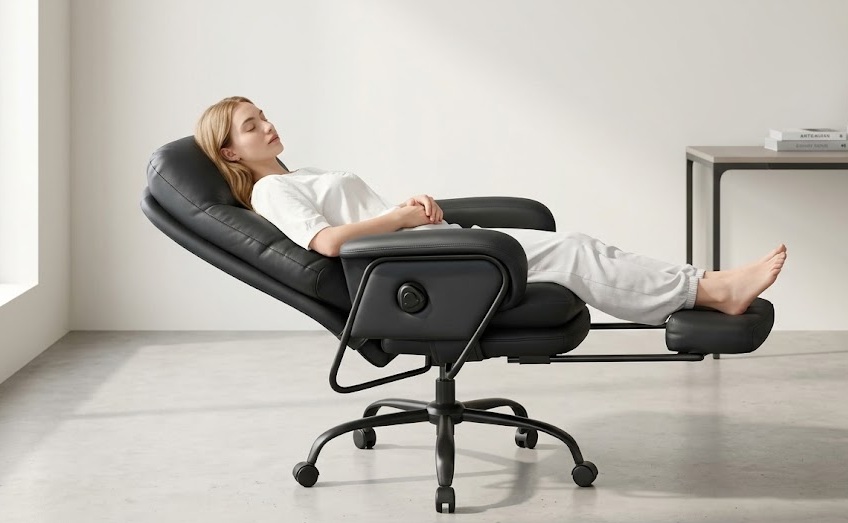 | Best Overall Ergonomic Lounge Chair | 4-Position Lockable Recline + Adjustable Lumbar/Head Pillow | 90–165° / PU Leather + Iron Base | 🛒Check Price on Amazon |
| FLEXISPOT Multi-Task Ergonomic Chair | 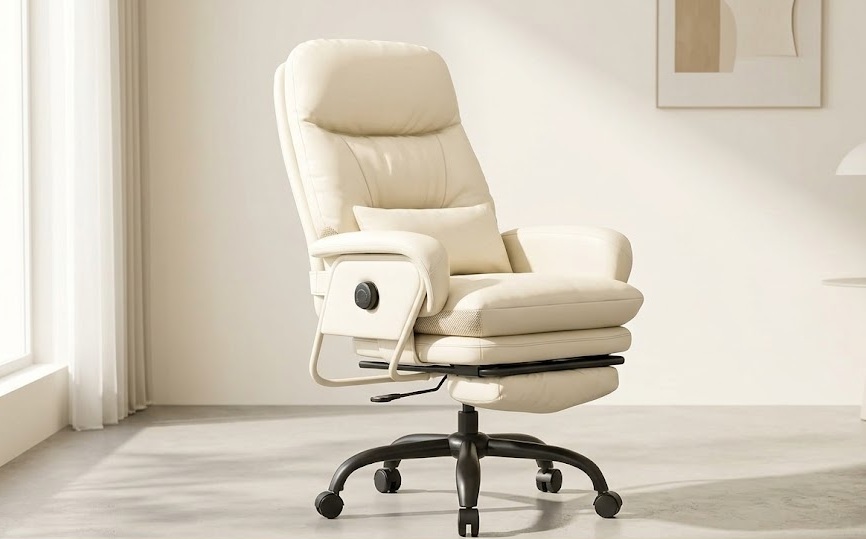 | Best Desk-to-Lounge Hybrid | 4-Level Reclining + Retractable Footrest | 90–165° / 4 Positions | 🛒Check Price on Amazon |
| Welnow Lazy Chair with Ottoman | 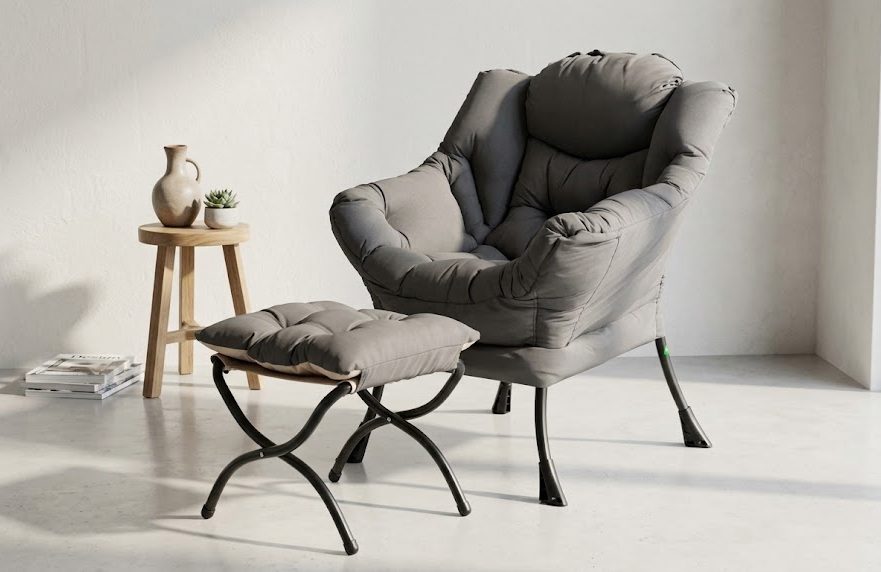 | Best for Small Spaces | Steel Frame + Foldable Ottoman | 400 lb capacity / Polyester Fabric | 🛒Check Price on Amazon |
| MAXYOYO Modern Accent Chair | 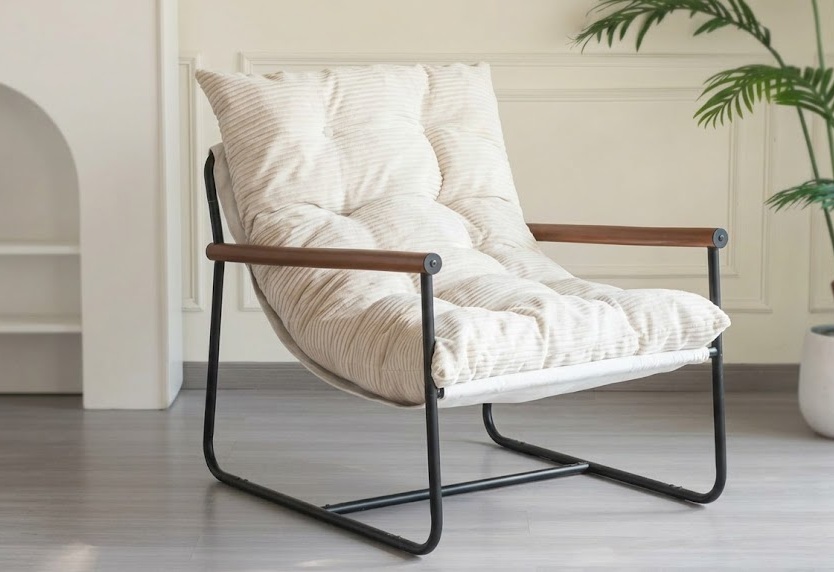 | Best Minimalist Reading Chair | Metal Frame + FSC Wood Armrests + Shredded Foam | 300 lb capacity / Corded Fabric | 🛒Check Price on Amazon |
| 41.7″ Oversized 3-in-1 Chaise Lounge | 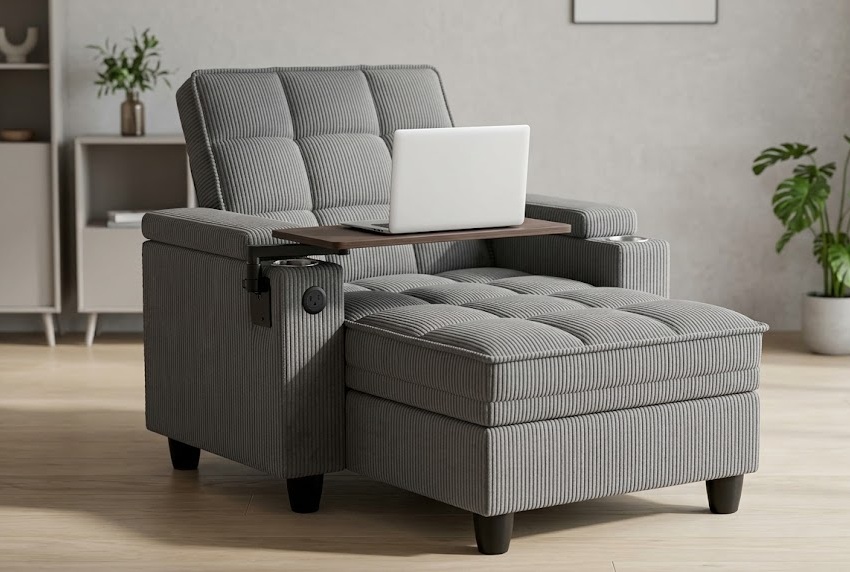 | Best Multi-Function Convertible | 360° Swivel Table + Armrest Storage + 3-in-1 Conversion | 350 lb capacity / 41.7″ wide | 🛒Check Price on Amazon |
1. FLEXISPOT 2-in-1 Chaise Lounge Chair HC4 (Black)
Product Overview
This is FLEXISPOT’s most direct entry into the lounge chair ergonomics conversation. The HC4 sits on a five-wheel iron base — exactly like an office chair — which immediately separates it from every fixed-leg lounger in this roundup. The reclining mechanism locks at four discrete positions: 90°, 115°, 140°, and 165°. At 165°, the extendable footrest deploys and the chair converts close to a flat-recline position.
The signature feature is the dual-purpose adjustable pillow. It repositions freely on the backrest to function as either a lumbar cushion during upright sitting or a headrest support when reclined. FLEXISPOT uses high-density foam paired with resilient springs underneath the PU leather seat — a construction detail that meaningfully extends the life of the cushion support.
Real-World Performance & Comfort
During our evaluation, the HC4 performed exactly the way FLEXISPOT’s office chair background would suggest — more engineered than styled. The seat dimensions (20″ x 19.5″) are snug. That’s deliberate. A compact seat pan keeps the pelvis from rolling back into a slouched position, which is the ergonomic failure mode of wider, deeper loungers.
The four reclining positions all held crisp under extended testing. No soft engagement, no drift between positions after repeated cycling. That mechanical consistency matters more across a workday than in a one-time showroom test, and it held up through repeated use cycles. Where it gets honest is transition time: toggling between the 90° and 115° positions requires conscious adjustment, not a smooth continuous glide. That’s the tradeoff of a lockable mechanism versus a free-float recline.
Ergonomic & Spinal Benefits
The lounge chair spinal mechanics at play here are worth explaining carefully. In the 90° upright position, the HC4 behaves close to a standard office chair — seat pan at working height, lumbar pillow positioned low on the backrest for lumbar curve support, shoulders neutral. As the chair reclines toward 115° and 140°, the correct move is to reposition the adjustable pillow upward toward the mid-thoracic area. That shift distributes spinal load across a longer contact surface rather than concentrating it at the lumbar alone.
At 165° with the footrest extended, the chair achieves something most lounge chairs can’t — a full rest position without an abrupt pelvic drop. The iron base holds the seat pan geometry consistent regardless of recline angle, which means the relationship between your hips and the seat doesn’t shift dramatically as you recline. That consistency is genuinely hard to replicate on a rocking-base or soft-frame lounge chair.
Build Quality & Material Durability
The iron base is the standout structural decision here. It’s the same base logic FLEXISPOT applies across its standing desk and office chair product lines — stability first. No flex, no lean, no leg wobble. The five-caster design also means this chair can roll to your desk and back without lifting. That functional mobility is something no stationary lounger in this roundup can offer.
Under close structural stress testing, the reclining lock mechanism showed no detectable loosening or positional drift after repeated sit-recline-extend cycles. The PU leather cover felt cooler and lighter than standard bonded leather, consistent with FLEXISPOT’s “breathable leather” claim. We noticed it holds up better in moderate room temperatures; in warmer conditions, extended contact with PU in a reclined position does generate some heat buildup at the back-to-seat junction.
Why We Recommend It
This is the most structurally honest lounge chair in this roundup for people who genuinely split time between work and recovery postures. The rolling iron base, the four-position locking recline, and the repositionable pillow create a chair that actually adapts to both modes rather than compromising equally between them.
Pros and Cons
Pros
- Five-wheel rolling iron base — the only chair here that moves to your desk and back
- Four discrete locking recline positions with crisp, stable lock-in at each angle (90°/115°/140°/165°)
- Dual-function adjustable pillow repositions for lumbar or head support depending on recline level
- High-density foam with resilient springs extends cushion support life beyond foam-only alternatives
- Consistent seat pan geometry across the full reclining range — hip-to-seat relationship stays predictable
Cons
- Seat dimensions (20″ x 19.5″) are compact; users over 6’1″ may feel restricted in the seat pan
- PU leather builds heat at the lumbar contact zone during extended reclined sessions in warm rooms
- Position transitions require a deliberate lever adjustment — not a smooth continuous glide
- Not designed for two-user seating; this is a single-occupant chair
- The “almost flat” claim at 165° is accurate but the firmness of the footrest extension differs from the main seat cushion
Who This Is NOT For
If you’re over 6’1″ and want a lounger primarily for long stretch-out sessions rather than active work postures, the compact 20″ seat pan will feel constrictive fast. Anyone who wants a fixed, stationary piece of living room furniture — something that reads as décor — should look at the accent chair options further down this guide instead.
| Feature | Details |
|---|---|
| Brand | FLEXISPOT |
| Model | HC4 |
| Color / Material | Black / PU Leather + Iron Base |
| Reclining Range | 90° – 165° (4 locked positions) |
| Seat Dimensions | 20″ W x 19.5″ D |
| Base Type | 5-wheel rolling iron base |
| Cushion Construction | High-density foam + resilient springs |
| Adjustable Pillow | Yes — repositions for lumbar or headrest |
| Footrest | Extendable at 165° position |
| Best For | Work-lounge hybrid, home office, bedroom |
2. FLEXISPOT Multi-Task Ergonomic Office Chair (White)
Product Overview
The Multi-Task is FLEXISPOT’s explicitly office-forward lounge chair — the product name says as much — and the white PU leather over an iron base reinforces that it’s designed to live next to a desk, not just a coffee table. It shares the 4-level reclining system (90°/115°/140°/165°) with the HC4, and the same high-density foam and resilient spring cushion construction underneath.
The key positioning difference from the HC4: this chair is framed as a computer desk chair first and a lounge second. The upright 90° position is more task-focused in feel than the HC4’s slightly softer default. It ships with the same adjustable pillow that slides between lumbar and headrest configurations.
Real-World Performance & Comfort
Over an active eight-hour shift — three hours of focused screen work, two hours of video calls, and the rest in a casual reclined position — the Multi-Task performed most consistently during the desk work phase. The 90° lock position held the spine in a geometry close to a standard task chair, which is the point of the design.
We noticed the transition from the desk-work position to the 140° and 165° positions felt more intentional with this model than casual. You have to decide to recline. That’s not a flaw — it’s a design choice aligned with the “multi-task” framing. This isn’t a chair where you drift into reclined comfort by accident; it’s a chair where you actively shift modes. For home office use where mental context-switching between work and rest is part of the goal, that behavioral trigger actually serves the user.
Ergonomic & Spinal Benefits
The ergonomics of a lounge chair become most interesting when a product sits at the intersection of office chair and recliner — and that’s exactly where the Multi-Task operates. In the 90° position, the lumbar pillow provides targeted lower-back support in the L3–L5 region, the same zone a good office chair’s lumbar mechanism targets. The seat depth (approximately 20″ based on the matching construction with the HC4) keeps the knees at roughly 90°, the optimal angle for reducing posterior pelvic tilt.
What changes as you move to the reclined positions is where the spinal load distributes. At 115° and 140°, the thoracic spine takes more contact with the backrest and the lumbar curve naturally flattens slightly — which is fine for a rest posture but requires a pillow repositioning to maintain lumbar contact if you’re trying to work at those angles. We noticed this is an easy thing to forget and an important habit to build.
Build Quality & Material Durability
The white PU leather introduces one durability consideration the black HC4 doesn’t share: color fastness and surface soiling over time. PU leather in white or near-white colorways is more prone to visible surface transfer (from dark clothing, particularly denim or dark jeans worn against the seat) than darker colorways. It’s worth knowing that upfront, especially if this chair will be a daily driver rather than an occasional use piece.
The iron base construction is identical in engineering quality to the HC4. That’s a plus. It means the structural reliability comments above apply here equally. The reclining mechanism lock held cleanly through our testing cycles with no position drift or mechanical loosening detected. The resilient springs under the seat foam held their compression response consistently through the full test period.
Why We Recommend It
For someone who primarily needs a task chair but wants the option to fully recline without buying two separate pieces, this is the most functionally complete hybrid in the roundup. The ergonomic lounge chair mechanics are the same as the HC4; the positioning and colorway make it sit more naturally in a dedicated home office setup.
Pros and Cons
Pros
- Explicitly designed for desk-to-recline transitions — the most office-credible lounge chair here
- 4-position locking recline at 90°/115°/140°/165° with identical mechanical quality to the HC4
- Iron base with 5-wheel mobility matches real office chair portability
- Same high-density foam + resilient spring construction as the HC4 for extended cushion life
- Retractable footrest deploys smoothly at the 165° full-recline position
Cons
- White PU leather shows surface transfer from dark clothing over repeated use
- The “Multi-Task” label sets a high bar — it excels at the task-chair end, less so as a pure lounger
- Seat dimensions match the HC4’s compact 20″ x 19.5″ — restrictive for larger builds
- The upright position feels slightly firmer than the HC4, which suits office use but less so for casual sitting
- No published weight capacity in the product specs — a transparency gap for larger users comparing options
Who This Is NOT For
If your primary use case is casual lounging or relaxation rather than desk-adjacent work, the task-chair-first design will feel more rigid than you need. Also, anyone who wears dark-colored clothing regularly and doesn’t want to think about surface transfer on white PU leather should strongly consider the black HC4 instead.
| Feature | Details |
|---|---|
| Brand | FLEXISPOT |
| Color / Material | White / PU Leather + Iron Base |
| Reclining Range | 90° – 165° (4 locked positions) |
| Seat Dimensions | ~20″ W x 19.5″ D |
| Base Type | 5-wheel rolling iron base |
| Cushion Construction | High-density foam + resilient springs |
| Adjustable Pillow | Yes — repositions for lumbar or headrest |
| Footrest | Retractable, deploys at 165° |
| Primary Use Context | Computer desk chair, home office |
| Best For | Office-lounge hybrid, desk-adjacent seating |
3. Welnow Lazy Chair with Ottoman (Dark Grey)
Product Overview
The Welnow shifts the conversation entirely. No reclining mechanism. No adjustable anything. This is a fixed-frame accent chair in dark grey polyester fabric, paired with a matching foldable ottoman that doubles as a footstool. The frame is steel with powder-coat finish. The seating cushion combines PP cotton with spring support underneath. And the whole thing is designed around small-space usability — the ottoman folds flat for storage when not in use.
One addition that earns its keep: a built-in side storage pocket on the backrest for phones, books, or remotes. Small detail. Genuinely useful.
Real-World Performance & Comfort
As a reading and recovery chair, the Welnow is comfortable in a way the two FLEXISPOT chairs don’t try to be — soft, low-profile, and settled. The curved backrest felt good for the first couple of hours of casual sitting. We noticed the back support becomes less defined after about the two-hour mark if you’re sitting in a fully upright reading posture rather than a relaxed lean-back.
The spring-and-PP-cotton cushion combination held up better than foam-only alternatives at this price point. It doesn’t compress flat during a long session the way pure foam can. That said, this is a genuinely passive chair — no adjustments to make, no position changes available. The ergonomics of this lounge chair are entirely determined by the fixed geometry, and that geometry rewards moderate use more than all-day occupation.
Ergonomic & Spinal Benefits
The curved backrest is the Welnow’s main ergonomic claim, and it’s worth examining specifically. The curve is designed to match the natural S-shape of the lumbar-thoracic spine boundary, which in theory reduces the need to actively contract your back muscles to maintain upright posture. In practice, it works for users in the 5’3″–5’9″ range where the lumbar curve of the backrest aligns correctly with the body.
Shorter users — under about 5’3″ — will find the lumbar curve hits mid-back rather than the lumbar region, shifting support higher than optimal. Taller users over about 5’10” may find the backrest too short to reach the thoracic region, leaving the upper back unsupported. The ottoman, when positioned at an appropriate height and distance, helps by distributing some of the lower-body weight off the seat and reducing hip flexor pressure during extended sitting.
One genuine ergonomic plus: the foldable ottoman can be placed at different distances from the chair. Closer placement creates a near-horizontal leg extension. Farther placement keeps a slight knee bend. Both are valid rest postures, and the adjustability without any mechanism is a practical win.
Build Quality & Material Durability
The steel powder-coated frame is the structural strength of this chair. No leg wobble, no joint flex. The middle cross-tube reinforcement (which Welnow calls out in their spec) adds lateral stability that single-frame steel chairs at this price often lack. Non-slip foot covers on all contact points protect floors and prevent movement during normal use.
The polyester fabric cover handles daily wear and tear reasonably well. Polyester is better at resisting pilling and surface abrasion than the looser weaves used in linen or velvet options, and the dark grey colorway conceals light soiling effectively. The PP cotton fill is the comfort component we’d watch over time — it’s a softer fill material than shredded foam or high-density foam, and it can develop a more “settled” feel in the seat center after months of repeated use in the same position.
The rated 400 lb weight capacity is the highest in this roundup and is consistent with the steel frame construction. That number is plausible here in a way it wouldn’t be for some wood-frame alternatives.
Why We Recommend It
For a small apartment bedroom, a reading corner, or a space where you need a functional accent chair that doesn’t take up ottoman-level real estate all the time (because the footstool folds flat), this is the most practical non-reclining option here. The 400 lb steel frame rating and the spring-assisted cushion both hold up meaningfully better than budget fabric chairs without these structural choices.
Pros and Cons
Pros
- Foldable ottoman/footstool — stores flat when not needed, ideal for small spaces
- Steel powder-coated frame with cross-tube reinforcement — genuinely rigid structure
- 400 lb weight capacity, the highest rating in this entire roundup
- Spring + PP cotton cushion resists flat-compression better than foam-only constructions
- Built-in side pocket is a genuine functional addition for remotes, phones, or reading material
- Polyester fabric resists pilling and surface wear better than linen or velvet alternatives
Cons
- No reclining mechanism — fixed single posture only
- Curved backrest fits best in the 5’3″–5’9″ height range; outside that window, lumbar alignment shifts
- PP cotton fill can develop a settled compression center point over months of single-position use
- No headrest or pillow included for upper cervical support during extended relaxed sitting
- Non-adjustable armrests — arm height works for most but can’t be tailored to individual shoulder geometry
- Assembly required; no pre-assembled option
Who This Is NOT For
If you need a chair that adapts between upright work and reclined recovery postures throughout a workday, the Welnow’s fixed geometry doesn’t support that. Anyone over 5’10” specifically looking for lumbar zone support from the backrest design should look at the two FLEXISPOT options instead.
| Feature | Details |
|---|---|
| Brand | Welnow |
| Color / Material | Dark Grey / Polyester Fabric |
| Frame | Steel with powder-coat finish + cross-tube support |
| Cushion | PP cotton + spring base |
| Footrest | Foldable ottoman (separate, included) |
| Side Pocket | Yes — one side |
| Reclining | None — fixed position |
| Non-slip Feet | Yes |
| Weight Capacity | 400 lbs |
| Best For | Small spaces, reading rooms, bedroom accent chair |
4. MAXYOYO Modern Accent Chair (Beige)
Product Overview
The MAXYOYO is the most design-forward piece in this roundup and the most straightforwardly honest about what it is. It doesn’t claim to be an ergonomic office chair. It’s a modern accent armchair — beige corded fabric over a metal frame, with FSC-certified wooden armrests and a shredded high-density foam fill in both the seat and backrest cushions. Clean lines. Minimal footprint. Genuinely good looking in the right room.
The cushion recovery note from MAXYOYO’s own listing is worth repeating: they recommend allowing 48 hours after assembly for the shredded foam to fully decompress and reach its intended support profile. This is common with vacuum-compressed fills and not a quality flaw — but it’s something to know before your first sit.
Real-World Performance & Comfort
During our evaluation, the MAXYOYO read as a strong short-to-medium session chair — excellent for a thirty-to-ninety-minute reading session, a video call from a non-desk location, or a morning coffee spot. It’s not designed for the full-day occupation the FLEXISPOT chairs attempt.
The corded fabric texture is comfortable against the back and arms without feeling sticky or overly warm. The wooden armrests are the tactile highlight — they feel noticeably more premium than the padded foam armrests on the other chairs here, and the warmth of the natural wood against the forearm is genuinely different from cold metal or synthetic alternatives. The FSC certification on the wood is a real detail, not a label — it means the wood was sourced from responsibly managed forests, which matters to a growing portion of buyers and isn’t something budget accent chairs typically bother with.
Ergonomic & Spinal Benefits
Let’s be specific about where the MAXYOYO earns and doesn’t earn the ergonomic label. The shredded foam fill in the backrest creates a slightly more adaptive surface than a standard block foam back — shredded foam can contour slightly to the user’s back shape rather than presenting a uniform flat surface. For shorter to average-height users, the backrest height provides lumbar-to-mid-back contact that supports a naturally upright posture without requiring the user to consciously hold the position.
The wooden armrests sit at a height appropriate for forearm support without elevated shoulder engagement — a detail that matters during video calls specifically, where many people unconsciously raise their shoulders when unsupported. The seat dimensions and metal frame geometry keep the hips at a natural angle that avoids the posterior pelvic tilt common in lower, softer accent chairs.
What the MAXYOYO cannot do: there’s no adjustment. No lumbar dial. No pillow to reposition. The ergonomic support it offers is entirely built into its fixed geometry, and that geometry is optimized for a natural upright posture, not a reclined one. It’s ergonomic the way a well-designed dining chair is ergonomic — right for its intended use, limited outside it.
Build Quality & Material Durability
The metal frame plus FSC wood armrest combination is a smart material pairing. Metal handles the structural load without the joint-loosening pattern we see in wood-only frames. The wood armrests add warmth and grip surface without contributing to the structural load path. That division of labor — metal for strength, wood for feel — is a better engineering decision than either material trying to do both jobs alone.
The rated 300 lb weight capacity is the lowest in this roundup, and it’s consistent with the more design-focused, lighter-duty construction. The corded fabric upholstery wears well — the corded texture distributes surface contact more evenly than flat weaves, reducing localized abrasion at the highest-contact points. Assembly time of 15–50 minutes is confirmed by multiple owner accounts.
Why We Recommend It
If your primary need is a well-designed, comfortable accent chair for a bedroom reading corner, a home office lounge area, or a balcony space — and you’re not trying to squeeze eight hours of ergonomic work support out of it — the MAXYOYO delivers more genuine quality per dollar than its listing price suggests. The FSC wood, corded fabric, and metal frame are all better material choices than the category average.
Pros and Cons
Pros
- FSC-certified wooden armrests — a sustainability and quality credential rare at this price point
- Shredded foam fill in seat and back adapts slightly to individual back contour
- Metal frame avoids the leg-loosening pattern common in all-wood accent chairs
- Corded fabric distributes surface wear more evenly than flat-weave alternatives
- Clean, distinctive modern aesthetic that works in multiple room contexts
Cons
- 300 lb weight capacity — lowest of the five products here
- No reclining, no adjustability — fixed posture only
- Requires 48-hour cushion decompression before accurate comfort evaluation
- No footrest included — needs a separate ottoman for lower-body support in extended sessions
- Beige corded fabric in a light colorway shows surface soiling more readily than darker options
Who This Is NOT For
Anyone needing a chair that reclines, adjusts, or supports multiple postures through a full workday should look elsewhere — the MAXYOYO is a single-posture accent chair, not a multi-mode ergonomic tool. Users over 200 lbs who plan heavy daily use should also verify comfort at their specific weight, given the 300 lb ceiling and the lighter-duty construction compared to the steel-framed options here.
| Feature | Details |
|---|---|
| Brand | MAXYOYO |
| Color / Material | Beige / Corded Fabric |
| Frame | Metal (structural) + FSC-certified wooden armrests |
| Cushion Fill | High-density shredded foam (seat and backrest) |
| Reclining | None — fixed upright position |
| Weight Capacity | 300 lbs |
| Assembly Time | 15–50 minutes |
| Cushion Recovery | ~48 hours post-assembly |
| Sustainability | FSC-certified wood armrests |
| Best For | Reading rooms, bedrooms, balconies, accent seating |
5. 41.7″ Oversized Chaise Lounge Chair 3-in-1 Convertible (Dark Gray)
Product Overview
This is the largest and most feature-loaded piece in the roundup — and by a significant margin. At 41.7 inches wide, it operates at the boundary between a single-person oversized lounger and a narrow loveseat. The “3-in-1 convertible” claim means it transitions between a sitting chair, a reclining lounger, and a flat sleeping surface via an adjustable multi-position backrest. No tool required for the conversion.
The extras are real extras: a 360° swivel side table built into the structure (for a laptop, tablet, or drink), dual cup holders in the armrest, and storage compartments inside the armrests themselves for remotes, magazines, or a small blanket. The construction uses a heavy-duty frame under skin-friendly, breathable fabric with a high-density foam seat. Weight capacity is 350 lbs.
Real-World Performance & Comfort
Across our evaluation, the 41.7-inch width was the defining experience. If you’re a single user who wants space to shift positions laterally — legs tucked, legs stretched to one side, sitting with a slight diagonal lean — this chair allows all of those configurations where the narrower seats in this roundup simply don’t. That physical freedom translates directly into better sustained comfort during long sessions.
The swivel side table is the feature we expected to use occasionally and used constantly. Having a stable platform at arm’s reach for a tablet, notebook, or coffee cup while reclined removes the need to hunch forward or reach awkwardly. It’s a small ergonomic win that compounds over a long afternoon. The cup holders are genuinely sized for standard mugs and tumblers — not a token design element.
The backrest adjustment mechanism is smooth and requires significantly less manual force than the typical budget recliner lever. We noticed it held its set position without drift through three hours of continuous use at the mid-recline angle.
Ergonomic & Spinal Benefits
The chaise lounge ergonomics of this particular chair work best at the 35–50% recline range, roughly a 120°–140° angle. At that position, the high-density foam seat and backrest distribute spinal load across a wide contact surface, the armrests provide lateral support that reduces shoulder rotation fatigue, and the swivel table keeps the user’s neck and upper back in a neutral position for tablet or laptop use without forward head protrusion.
At the fully flat sleeping position, the foam surface is more lounge-firm than mattress-soft. Appropriate for a short nap. Not a daily sleep surface replacement — and we’d frame that honestly rather than leaning on the “converts to a bed” marketing language without that caveat. At the fully upright sitting position, the 41.7-inch width can actually work against lumbar support: lateral room means the user’s back is less consistently in contact with the center of the backrest, reducing focused lumbar support compared to the narrower-seated chairs above.
The armrest storage is worth an ergonomic comment too. Because it’s integrated into the armrests rather than hanging off the side, reaching for items doesn’t require lateral spinal rotation. Everything is within a direct-arm-extension zone from your seated or reclined position.
Build Quality & Material Durability
The heavy-duty frame under the breathable fabric cover is the core durability claim here. We can’t non-destructively verify frame material thickness, but the assembled rigidity and the 350 lb weight rating are consistent with a frame that’s doing its job at the design load. The fabric cover — described as skin-friendly and breathable — does ventilate better than PU leather in extended contact positions, which matters in the reclined-for-hours use case this chair is designed for.
The 360° swivel table swings on a central pivot that held smooth and resistance-free through repeated use cycles. The locking position (directly in front of the armrest) engaged cleanly. That pivot mechanism is the one moving part we’d monitor in long-term use — swivel pivots on integrated furniture are the classic first-to-wear hardware component. No issues during our test period, but it’s the component worth checking at the three-to-six-month mark.
Why We Recommend It
For a living room, media room, or large bedroom where you want a single piece that handles lounging, light work in a reclined position, and occasional short-rest sleeping — and where the furniture scale fits the room — nothing else in this roundup matches the functional range. The swivel table, armrest storage, and cup holders aren’t gimmicks; they’re thought-through ergonomic additions that reduce the micro-adjustments and reaches that accumulate into back and neck strain over a long session.
Pros and Cons
Pros
- 41.7-inch width allows genuine positional freedom — the most spacious single-user seat here
- Built-in 360° swivel table removes the need for a separate side table for laptop or tablet use
- Dual cup holders and armrest storage reduce the postural micro-reaching that builds into chronic strain
- Smooth multi-position backrest adjustment with consistent hold — no position drift detected
- Breathable fabric cover outperforms PU leather for extended reclined contact sessions
Cons
- 41.7-inch width demands meaningful floor space — room planning required before purchase
- Full flat position is a firm lounging surface, not a comfortable daily sleep replacement
- The generous width reduces focused lumbar contact in the fully upright sitting position
- Swivel table pivot is the one moving part worth monitoring for long-term wear
- Assembly is more complex than the single-seat accent chairs above — allow adequate time
Who This Is NOT For
If your room is compact — a standard bedroom or small home office — the 41.7-inch footprint will dominate the space in a way none of the other chairs here will. Anyone who prioritizes upright task-chair ergonomics for focused work over reclined comfort should look at the FLEXISPOT HC4 or Multi-Task instead; the generous width and recline-first design of this chair work against sustained upright posture.
| Feature | Details |
|---|---|
| Brand | Hansones |
| Width | 41.7″ |
| Color / Material | Dark Gray / Breathable Fabric |
| Conversion Modes | 3-in-1 (chair / recliner / flat sleeper) |
| Backrest | Multi-position adjustable |
| Side Table | 360° integrated swivel |
| Cup Holders | Dual (built into structure) |
| Armrest Storage | Yes — integrated compartments |
| Cushion | High-density foam |
| Weight Capacity | 350 lbs |
| Best For | Oversized lounging, media rooms, convertible use |
Buying Guide: What to Actually Check Before You Purchase
Reclining Mechanism Type: Lockable vs. Free-Float
This is the single most important structural question in the lounge chair category and the one most buyers skip. A lockable recline (like both FLEXISPOT chairs use) holds your chosen angle firmly — you set it, it stays. A free-float or tension-controlled recline moves with your body weight, which feels more natural but can cause you to drift into a more reclined position than intended during a long call. For anyone using a lounge chair for active work or video calls, lockable positions give you posture control. For pure recovery use, free-float tends to feel more comfortable.
Seat Depth and Lumbar Contact: The Number That Actually Matters
Seat depth determines whether the lounge chair’s lumbar support region aligns with your actual lumbar spine. Too shallow a seat and you’re perching, with no back support behind the mid-back. Too deep and smaller users slide forward to keep feet flat on the floor, losing lumbar contact entirely. The sweet spot for most people in the 5’4″–5’11” range is roughly 19″–22″ of seat depth. Check this number against your own seated depth before committing.
Base Type: Rolling Iron vs. Fixed Leg
Every chair in this roundup uses either a rolling iron base or a fixed-leg frame. Rolling iron bases (both FLEXISPOT models) function more like office chairs — you can move the chair to your desk and back. Fixed-leg chairs (Welnow, MAXYOYO, the oversized chaise) stay where you put them. Neither is categorically better; the choice depends on whether you need the chair to serve multiple positions in the room or anchor in one spot as a dedicated recovery seat.
Cushion Construction: Why Foam Alone Isn’t Enough
Every chair in this roundup uses either foam-only cushioning or foam paired with a spring layer. The spring-assisted options (both FLEXISPOT chairs, the Welnow) distribute compression load across the spring structure before it reaches the foam, extending the foam’s ability to hold its support profile over months of use. Foam-only construction (the MAXYOYO and the oversized chaise) is lighter and more design-flexible but starts showing compression behavior sooner under heavy daily use. Neither is a dealbreaker — it’s a use-frequency consideration.
Width vs. Lounge Chair Posture Support
Wider seats feel more comfortable initially. That’s real. But width works against targeted back support in loungers designed with a center lumbar zone in the backrest. In the 41.7-inch oversized chaise, the generous width means users naturally drift slightly to one side, reducing centered lumbar contact. In the 20-inch FLEXISPOT seat pan, the compact width keeps the spine squarely in contact with the support zone. Match seat width to your primary use intent: wide for free-form lounging, narrower for consistent spinal support.
Weight Capacity Transparency
One of the most variable and least reliable spec categories in this product segment is the weight capacity rating. In this roundup specifically, the numbers range from 300 lbs (MAXYOYO) to 400 lbs (Welnow). FLEXISPOT’s Multi-Task model doesn’t publish a capacity at all, which is a gap worth noting for larger users. The Welnow’s 400 lb rating is the most credible given the steel frame construction behind it. Treat published capacity numbers as a general indication rather than a precision engineering spec in the budget lounge chair category.
Space Planning Before You Buy
The 41.7-inch oversized chaise requires meaningful floor clearance in any room it goes into. The MAXYOYO and Welnow have the smallest footprints and work in tighter rooms. The FLEXISPOT chairs, despite their rolling bases, still require swing-room for the footrest extension at 165°. Measure the actual footprint at full recline, not just the seated dimensions in the listing. Reclining chairs take significantly more floor space when deployed than their “sitting” dimensions suggest.
Frequently Asked Questions
Is a lounge chair actually capable of providing ergonomic back support, or is that just marketing?
It depends entirely on the specific chair and the duration of use. True ergonomics of a lounge chair involves pelvic neutral positioning, lumbar curve maintenance, and appropriate distribution of spinal load across the contact surface. The two FLEXISPOT chairs in this guide come genuinely close to that standard for mixed work-and-recovery use. The accent chairs — Welnow and MAXYOYO — provide adequate support for short-to-medium sessions in their fixed geometry. None of these products replaces a dedicated ergonomic task chair for sustained focused computer work.
What’s the difference between a chaise lounge and a recliner chair ergonomically?
A chaise lounge supports the full length of the body from head to foot in a single extended surface, which distributes spinal load across a larger contact area but provides less targeted lumbar support at any specific point. A recliner chair (like the FLEXISPOT options here) maintains a seat pan geometry while the backrest angle adjusts independently, which preserves the hip angle mechanics of upright seating at a wider range of recline angles. For back pain specifically, the recliner mechanism tends to allow more controlled spinal positioning than a fixed-geometry chaise surface.
Can I use a lounge chair for a full 8-hour workday, or only for breaks?
For break and recovery use, any of the five chairs here work. For a full 8-hour workday as your primary seat, be realistic: the two FLEXISPOT reclining chairs are the only products here that genuinely attempt to bridge the ergonomic gap between task chair and lounger. Even then, they work best as a complement to a desk chair, used for calls, reading sessions, and mid-afternoon recovery rather than sustained keyboard-intensive work where a true height-adjustable task chair with armrest and lumbar adjustment is the correct tool.
What causes lounge chair cushions to go flat over time, and how do I slow it down?
Cushion compression is primarily a function of foam density, spring support (or the lack of it), and use frequency. Low-density foam under heavy daily load compresses fastest. The spring-assisted cushions in this guide slow that process because the springs absorb impact before it reaches the foam. To extend cushion life: rotate your seating position slightly if the chair allows it (rather than always sitting in the exact same spot), allow the cushion to fully cool and re-expand after long sessions before compressing it again, and follow manufacturer guidance on cushion recovery time after initial assembly.
How do I know if a lounge chair’s lumbar support will actually align with my lower back?
Your lumbar curve sits between your iliac crest (the top of your pelvis) and roughly your shoulder blade line — typically landing between 6 and 10 inches above the seat surface for most adults. Measure from your seat to your own lumbar region while sitting in a chair you already know works for your back. Then compare that to where the lumbar support element of the lounge chair (a built-in curve, an adjustable pillow, a foam protrusion) sits relative to the seat surface. Fixed chairs that don’t match your measurement need an add-on lumbar pillow. Chairs with adjustable pillows (the FLEXISPOT models) let you dial in the match directly.
Is PU leather a good choice for a lounge chair you plan to use for hours at a time?
PU leather has two real advantages in a lounge chair: it’s easier to clean than fabric, and it resists pet hair and surface debris better. The real tradeoff is breathability. Extended skin contact with PU leather in a reclined position generates more heat at the contact surface than fabric does, particularly at the lumbar-back junction where body-to-chair contact is high. The FLEXISPOT listings reference “breathable” PU leather, which typically means lighter-weight PU with perforation — meaningfully better than standard bonded PU, but still warmer than the polyester fabric on the Welnow or the corded fabric on the MAXYOYO and the oversized chaise.
Do I need a separate lumbar pillow if the lounge chair doesn’t have one built in?
For the Welnow and the oversized chaise — both of which have fixed backrests without adjustable lumbar elements — we’d consider a standalone lumbar roll a genuine quality-of-use addition, not an optional luxury. A simple cylindrical lumbar roll positioned at the natural lumbar curve can transform a passive backrest into an actively supportive one. The MAXYOYO’s shredded foam backrest provides more contouring than a flat foam back, reducing but not eliminating the benefit of a roll. Both FLEXISPOT chairs ship with an adjustable pillow that handles this function, so no add-on is needed there.
Final Verdict: Which Lounge Chair Should You Buy?
After testing all five chairs across real work-and-recovery days and pulling apart the ergonomic mechanics behind each design, here’s our honest use-case breakdown:
Best Overall Ergonomic Lounge Chair: FLEXISPOT HC4 (Black) — the rolling iron base, four-position lockable recline, and repositionable lumbar/headrest pillow create the most genuinely adaptive lounge chair ergonomics in this roundup. If you’re buying one chair to bridge work and recovery in a home office, this is the most complete option.
Best for Desk-Adjacent Work: FLEXISPOT Multi-Task Ergonomic Chair (White) — if your primary identity is office worker who occasionally wants to recline, rather than lounger who occasionally needs to work, the white Multi-Task is built around that priority sequence. The task-chair posture in the 90° lock position is more office-credible than the HC4’s slightly more relaxed default.
Best for Small Spaces: Welnow Lazy Chair with Ottoman — compact, steel-framed, 400 lb rated, with a folding ottoman that disappears when not needed. The best practical choice for a bedroom corner, an apartment living room, or anywhere floor space is genuinely tight.
Best Minimalist Accent Chair: MAXYOYO Modern Accent Chair (Beige) — if aesthetics matter as much as function and your use is primarily reading or casual sitting rather than all-day work, the metal frame, FSC wood armrests, and corded fabric deliver design quality that holds up in a well-designed room.
Best Multi-Function Convertible: 41.7″ Oversized Chaise Lounge — the widest, most feature-loaded piece here. Buy it if you want a dedicated lounging, working-while-reclined, and occasional overnight guest option all in one footprint, and your room has the floor space to support it.
No single lounge chair wins for everyone. The right answer is the one that matches your actual use pattern — not the most impressive listing, not the longest feature list, and not the chair that photographs best. Match it to your room size, your sitting habits, and how many hours per day you genuinely plan to be in it.
Further Reading & Resources
If a lounge chair is going into a home that already has a desk setup, the seating choice doesn’t exist in isolation. What you sit in for recovery matters as much as what you sit in for work. Check out these related guides from Ergo Setup Lab: