
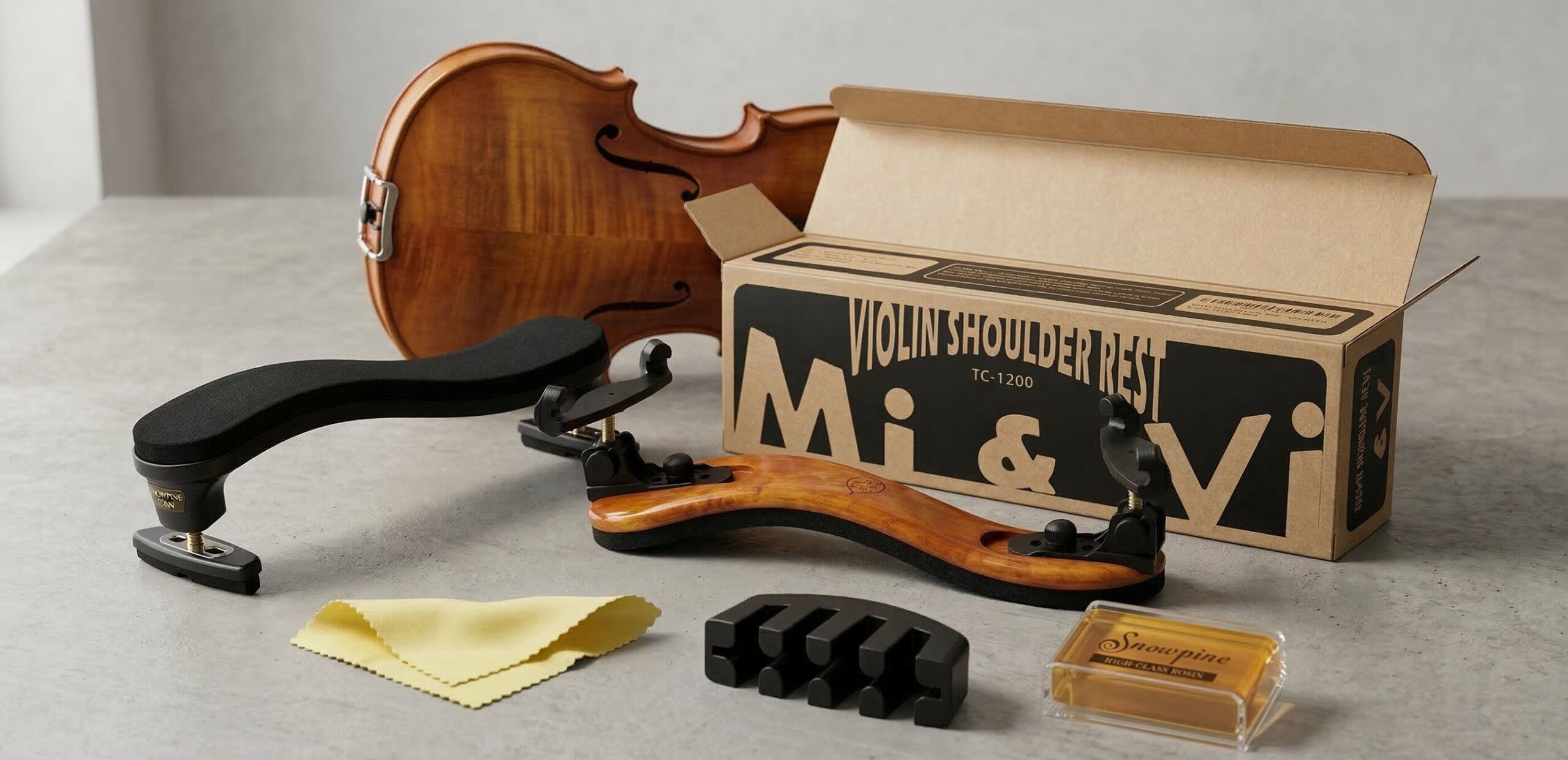
Imagine the sweeping bow strokes of a masterful concerto, the rich vibrato resonating through a silent concert hall, and the rapid, flawless shifting of your left hand—now imagine executing all of that without the biting, pinching pain in your collarbone. For decades, violinists have accepted neck stiffness and shoulder aches as the necessary price of mastering their instrument. However, just as modern office workers rely on supportive chairs to prevent back strain, musicians must rely on the right supportive gear to prevent repetitive strain injuries. Clamping down on a hard wooden instrument for hours forces your body into an unnatural, asymmetrical posture. By upgrading your setup with a high-quality ergonomic violin shoulder rest, you can transform your daily practice from a grinding test of physical endurance into an immersive session of pure musical joy.
Whether you are a seasoned orchestral professional navigating Wagnerian operas, a dedicated teacher guiding the next generation, or a passionate adult beginner learning your first scales, the physical support of your instrument dictates your technical ceiling. Without proper elevation and padding, your left hand is forced to support the instrument’s weight, which instantly throttles your shifting speed and chokes your vibrato. Investing in an ergonomic violin shoulder rest allows the instrument to float naturally along your jawline, freeing your hands to dance across the fingerboard. This comprehensive guide will break down the anatomy of musician fatigue, outline the essential features to look for, and review the absolute best products currently dominating the market.
Understanding Ergonomics: Why an Ergonomic Violin Shoulder Rest Matters
Ergonomics is the applied science of designing equipment that fits the human body and its cognitive abilities perfectly. When applied to string instruments, it plays an invisible yet monumental role in ensuring that your neck, jaw, and left arm are correctly supported to foster high-level technical performances rather than chronic pain. Because violins were designed centuries ago, their physical shape does not conform to the natural curves of the modern human collarbone. Standard pads or playing without any support entirely fails to accommodate the body’s natural resting state during hours of rigorous repetition.
Most traditional sponges or flat plastic rests create an awkward, unbalanced gap between the jaw and the collarbone. This leaves musicians struggling to maintain a secure hold without constantly shrugging their left shoulder upward—a highly damaging micro-movement. An expertly crafted alternative, like a well-designed ergonomic violin shoulder rest, eliminates the common issues of slipping, muscle fatigue, and poor spinal alignment that arise from prolonged playing. These specialized pieces of equipment are tailored to contour precisely around the chest and shoulder bone, providing the exact weight relief and elevation required to keep your delicate neck muscles perfectly aligned. When you prioritize a premium ergonomic violin shoulder rest, you are essentially investing in the longevity of your musical career.
The Pitfalls of Standard Accessories vs. an Ergonomic Violin Shoulder Rest
When violinists attempt to use cheap, standard, non-ergonomic foam pads—or worse, no support at all—several mechanical failures and physical frustrations almost always occur. Recognizing these pitfalls is the first crucial step toward making a better purchasing decision.
The “Violin Hickey” and Skin Irritation: Playing with inadequate support forces players to press their jaw down with immense pressure to stabilize the instrument. This constant, harsh friction against the chinrest leads to painful bruising and the infamous “violin hickey” on the neck. An ergonomic violin shoulder rest raises the instrument to meet your jaw, entirely removing the need for downward clamping pressure.
Restricted Left-Hand Technique: If you are not utilizing an ergonomic violin shoulder rest, your left hand must do double duty: fretting the notes and holding the instrument up. This completely locks the thumb, making fluid shifting into higher positions and relaxed, rolling vibrato physically impossible. The right support takes 100% of the instrument’s weight off the left hand.
Constant Slipping: Traditional, flat shoulder rests lack proper body contouring. Because the human chest is curved, flat plastic accessories act like a seesaw, constantly sliding down the chest during energetic bowing. A high-quality contoured rest wraps around the shoulder, locking the instrument securely into place.
The Anatomy of Musician Fatigue: How an Ergonomic Violin Shoulder Rest Helps
To truly grasp why an upgrade is absolutely necessary, we must examine how bodily fatigue develops on a muscular level while playing. The neck and upper back consist of an intricate web of ligaments and muscles, including the trapezius and the levator scapulae, which are highly susceptible to repetitive strain injury (RSI). When you try to grip a violin with your chin and a shrugged shoulder, your intrinsic muscles remain in a state of continuous, exhausting isometric contraction. They are firing constantly just to keep the instrument parallel to the floor before your fingers even begin their rapid movements.
By introducing an ergonomic violin shoulder rest, you are actively accommodating the biological limits of your skeletal system. A contoured support structure allows your neck to remain in a neutral, straight position. Instead of fighting against gravity and the rigid wood of the violin, the ergonomic violin shoulder rest works in perfect harmony with your natural biomechanics. Furthermore, the nerves that run from your cervical spine down through your arm are spared from being compressed, effectively preventing the numbness, tingling, and radiating pain that so often plague dedicated musicians during long-haul symphony rehearsals.
Key Features to Look for in a Quality Ergonomic Violin Shoulder Rest
When shopping for the ultimate support accessory to add to your musical arsenal, there are several key structural features to heavily evaluate. You need a tool that adapts to your specific neck length, shoulder slope, and overall biomechanical needs.
Multi-Axis Adjustability: The most defining feature of a comfort-focused rest is its ability to be customized. You should look for rests that allow you to adjust the height on both the chest side and the shoulder side independently. The best ergonomic violin shoulder rest will also allow you to adjust the width and the pitch angle to perfectly match the slant of your collarbone.
High-Density Resilient Foam: Comfort heavily relies on the padding material. Premium models feature high-density EVA foam or neoprene that does not compress flat over time. This ensures that the accessory remains soft against your body while maintaining the required elevation.
Acoustically Transparent Materials: The material of the base directly affects the tone of your instrument. Look for an ergonomic violin shoulder rest made from resonant maple wood, carbon fiber, or high-grade tempered aluminum. These materials transfer vibrations efficiently, ensuring that adding a support structure does not mute or dampen the natural overtones of your beloved instrument.
Non-Marring Rubber Feet: To protect the expensive varnish on your violin, the grasping feet (or “claws”) must be coated in thick, surgical-grade silicone or rubber. This ensures a vice-like grip on the instrument without leaving a single scratch on the delicate wood.
Top 5 Recommendations: The Best Ergonomic Violin Shoulder Rest Models on the Market
Finding the right support offers the perfect blend of physical relief, aesthetic beauty, and acoustic enhancement. Here are our top 5 trending, highly-rated recommendations on Amazon when shopping for the best ergonomic violin shoulder rest options on the market:
| Product Name | Product Image | Category | Main Feature | Buy Now |
| Branger Adjustable | 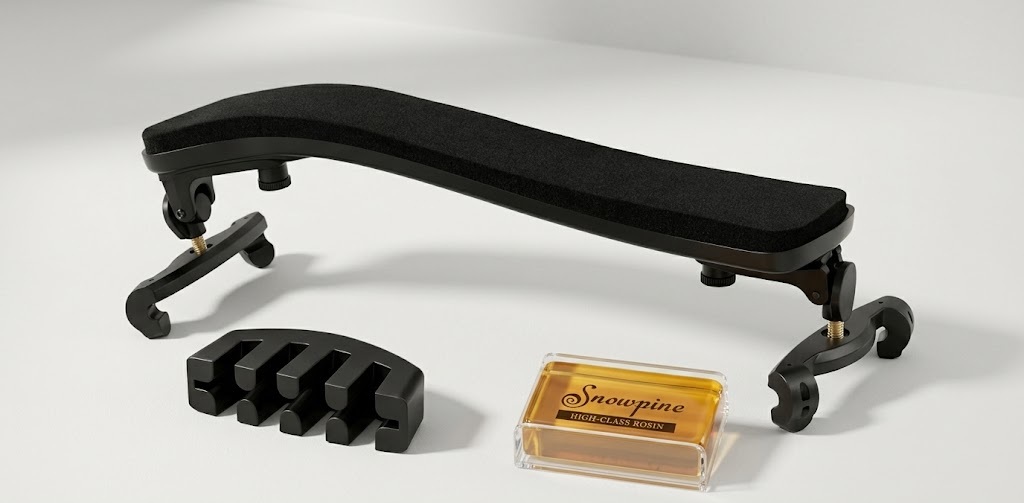 | Best Collapsible Ergo | Built-in Practice Mute | 🛒Check Price on Amazon |
| Everest EZ4A | 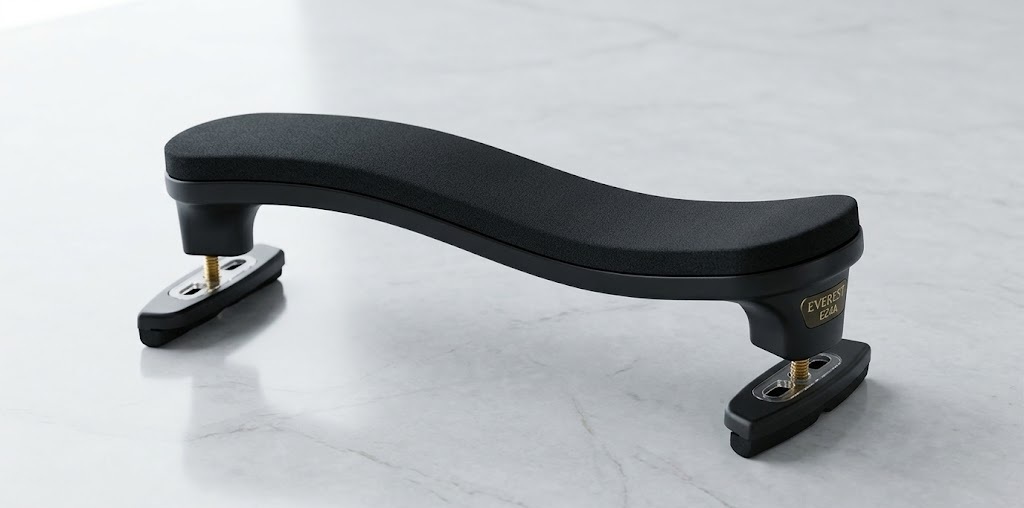 | Best Fixed-Tilt Ergo | Computer-Modeled Curve | 🛒Check Price on Amazon |
| Ergonomic Student | 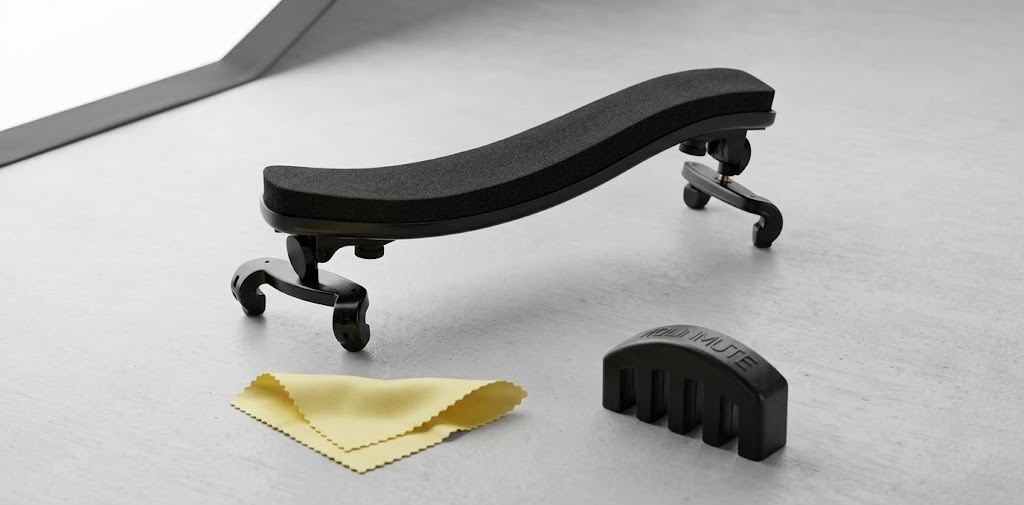 | Best Beginner Ergo | Thick Comfort Foam | 🛒Check Price on Amazon |
| MI-VI Real Wood | 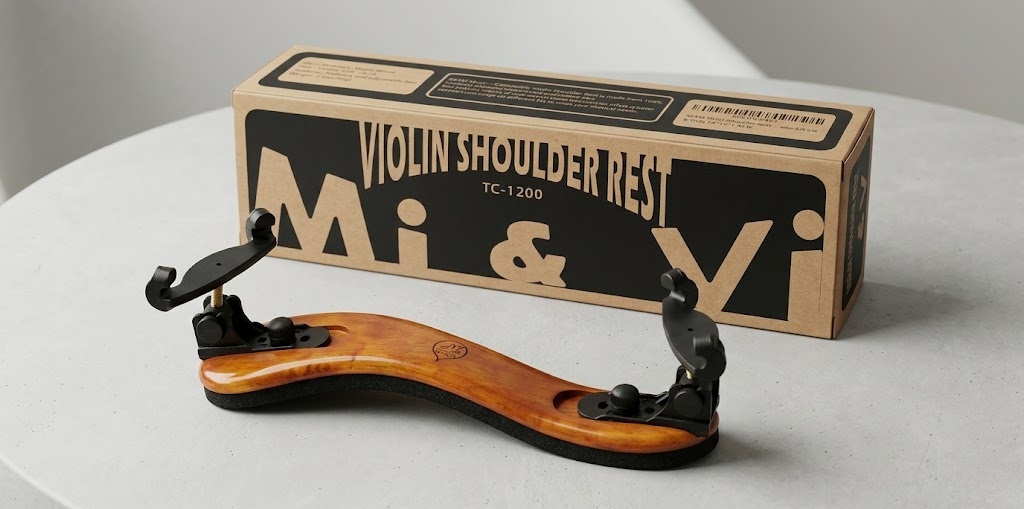 | Best Acoustic Ergo | Authentic Maple Wood | 🛒Check Price on Amazon |
| Bon Musica BHBU | 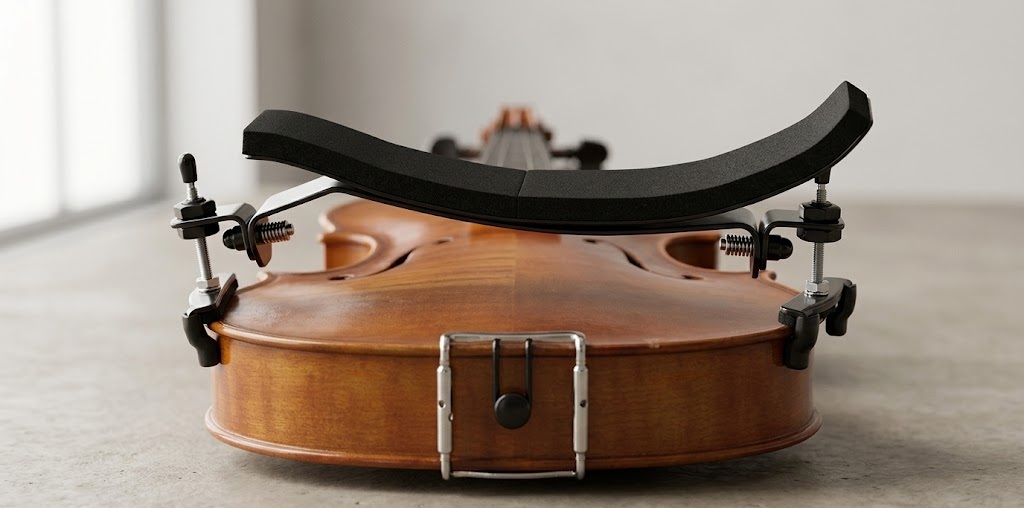 | Best Custom-Fit Ergo | Bendable Aluminum Base | 🛒Check Price on Amazon |
1. Branger Collapsible Adjustable Violin Shoulder Rest
The Branger Adjustable model is a highly celebrated choice that offers fantastic convenience and sturdy construction. Featuring a collapsible foot mechanism, it easily folds flat to fit into the small accessory compartments of almost any standard instrument case, making it an incredibly user-friendly option.
| Feature | Details |
| Material | ABS Plastic base with thick EVA Foam |
| Size | Fits 4/4 to 3/4 sizes |
| Design | Collapsible feet for easy storage |
| Specialty | Comes bundled with a heavy rubber practice mute |
Pros:
- Highly portable design that folds flat seamlessly.
- The included practice mute is an excellent bonus for apartment dwellers.
- Sturdy gripping claws prevent mid-performance slipping.
Cons:
- The curvature is slightly generic and cannot be physically bent.
- ABS plastic does not provide the same acoustic resonance as genuine wood.
2. Everest EZ4A Violin Shoulder Rest
Designed in the USA by biomedical engineers, the Everest EZ4A is built specifically to address the anatomical shortcomings of traditional designs. This model utilizes a patented fixed-tilt design that raises the instrument to an ergonomically correct and comfortable playing angle without complex setup.
| Feature | Details |
| Material | High-grade, unbreakable ABS material |
| Size | Fits 4/4 to 3/4 sizes |
| Design | One-piece body integrated with adjustable legs |
| Specialty | Computer-modeled curve for perfect anatomical alignment |
Pros:
- Extremely durable; no swivel mechanisms or thumb knobs to break or lose.
- The fixed tilt automatically trains beginners to hold the violin at the proper angle.
- Neoprene padding provides excellent, long-lasting comfort.
Cons:
- Lacks the ability to collapse, meaning it may not fit in extremely tight, shaped cases.
- The rigid body cannot be bent or molded to highly unusual shoulder slopes.
3. Ergonomic Violin Shoulder Rest for Students Beginners
When looking for an affordable, highly cushioned entry point into proper posture, this generalized beginner model stands out. It provides an exceptionally thick layer of foam padding designed to eliminate the initial collarbone pain that causes many young students to quit early.
| Feature | Details |
| Material | Lightweight composite with extra-thick foam |
| Size | Fully adjustable for 4/4 to 3/4 sizes |
| Design | Streamlined, lightweight body arrangement |
| Specialty | Budget-friendly focus on intense localized cushioning |
Pros:
- Exceptionally soft padding prevents bruising on sensitive collarbones.
- Very lightweight, ensuring the instrument does not feel overly heavy.
- Simple screw mechanisms are easy for younger students to adjust.
Cons:
- The foam can degrade faster under heavy, professional daily use.
- Lacks the advanced angular adjustments required by professional soloists.
4. MI-VI Violin Shoulder Rest
For purists who demand both physical relief and uncompromising acoustic tone, the MI-VI model is the pinnacle of the premium market. Crafted from genuine resonant maple wood, this rest acts as a natural extension of the instrument, ensuring that your sound vibrations travel freely.
| Feature | Details |
| Material | Authentic Maple Wood with high-density foam |
| Size | Ideal fit for 4/4 and 3/4 sizes |
| Design | Smooth, aesthetically pleasing curved support bar |
| Specialty | Anti-aging silicone feet to protect delicate varnishes |
Pros:
- Real wood construction ensures strong acoustic enhancement and zero muting.
- The gorgeous aesthetic perfectly matches the back of a high-quality violin.
- Highly secure, anti-aging silicone feet provide a vice-like, protective grip.
Cons:
- Wood is naturally heavier than hollow plastic alternatives.
- The wooden base is completely rigid and cannot be custom-molded to the shoulder.
5. Bon Musica BHBU0503A574 Bonmusica Shoulder Rest
The Bon Musica is widely considered the ultimate ergonomic solution for players with long necks or highly specific anatomical needs. Made in Germany, its most defining feature is its pliable metal base, which allows the player to literally bend the accessory until it perfectly hugs the unique shape of their body.
| Feature | Details |
| Material | Plastic-coated aluminum with foam rubber padding |
| Size | 4/4 size (other sizes available separately) |
| Design | Extended hooked shape that locks over the shoulder |
| Specialty | Fully bendable base for 100% custom contouring |
Pros:
- Unmatched customization; the metal can be bent for the ultimate personalized fit.
- The “hook” design wraps over the back of the shoulder, making it totally hands-free.
- Extra-long leg screws allow for massive height adjustments, perfect for long necks.
Cons:
- It is bulky and rarely fits inside standard violin cases without complete disassembly.
- The metal components can be heavy, taking some time to get used to.
Comparison of Popular Models: Finding Your Ideal Ergonomic Violin Shoulder Rest
Choosing the perfect model comes down to balancing your budget, your physical anatomy, and your acoustic preferences. If your primary goal is portability and seamless travel to and from rehearsals, a collapsible plastic model like the Branger is an excellent, low-fuss choice. It packs away quickly and gets the job done.
However, if you suffer from severe neck pain, instability, or have a longer-than-average neck, the choice is unequivocally the Bon Musica. The ability to utilize the bendable metal molding on this ergonomic violin shoulder rest is an absolute game-changer, turning a slippery instrument into a securely locked extension of your torso. Conversely, for the audiophile who refuses to dampen their instrument’s ringing overtones, the MI-VI maple wood model acts as the best balance between an elegant, traditional aesthetic and modern physical support.
Health Benefits of an Ergonomic Violin Shoulder Rest for Joint Support
The health benefits of transitioning to a premium support system extend far beyond just your collarbone. When you use a proper, balanced instrument setup, you are forced to stand with your chest squared and open, rather than hunched over with a collapsed left lung. This open-chest posture dramatically improves your breathing capacity, allowing for better oxygen flow and more dynamic musical phrasing.
Furthermore, an expertly adjusted ergonomic violin shoulder rest heavily mitigates the risk of carpal tunnel syndrome and tendonitis in the left wrist. Because the correct support setup places the instrument at a natural upward angle without requiring your left hand to hold it up, you do not have to clench your thumb against the neck of the violin. By keeping the left hand in a neutral, floating, tension-free state, the fingerboard is fully navigated with ease. You can execute lightning-fast trills, perform buttery-smooth shifts, and ultimately enjoy your repertoire on a much deeper, pain-free level.
How to Properly Attach and Hold Your Ergonomic Violin Shoulder Rest
Purchasing the highest-rated gear is only half the battle; how you attach it dictates its effectiveness. To get the maximum benefit out of your new ergonomic violin shoulder rest, you must ensure the feet are securely fastened to the widest part of the violin’s lower bout. The rest should sit at a slight diagonal angle across the back of the instrument. When you raise the violin to playing position, the pad should rest firmly on your collarbone and slightly drape over the front of your shoulder. Your head should naturally drop onto the chinrest with the weight of gravity alone—if you find yourself actively pulling your chin down to hold it steady, you need to extend the leg screws to increase the height.
Deep Dive: The Science of Body Contours and Materials
The interplay between materials and physical comfort cannot be overstated. Traditional rigid plastics often create localized pressure points that restrict blood flow to the skin, causing dull aches. By utilizing advanced materials like layered EVA foam and neoprene, modern manufacturers ensure that the weight of the instrument is dispersed evenly across a larger surface area of the shoulder. This scientific approach to weight distribution means that even a heavy, solid-wood instrument feels virtually weightless.
The Psychology of Musical Comfort
There is a powerfully unseen psychological component tied to physical comfort during performance. When you are in pain, your brain naturally releases stress hormones that stifle creative expression and tighten your muscles. If you dread picking up your instrument because you know your neck will cramp in twenty minutes, your practice efficiency plummets. Investing in a comfortable setup shifts your entire mindset. The instrument becomes an inviting, comforting extension of your body rather than a cumbersome obstacle, allowing you to easily slip into a “flow state” where technical difficulties fade away.
Maintaining and Caring for Your Ergonomic Violin Shoulder Rest
To ensure your gear continues to provide fluid, pain-free support for years, simple but regular maintenance is required. Sweat, dead skin, and rosin dust can easily get trapped in the foam padding and the threading of the adjustable screws. This buildup can degrade the foam and cause the metal leg screws to seize up entirely.
Once a month, wipe down the rubber padding of your ergonomic violin shoulder rest with a slightly damp, lint-free cloth to remove acidic skin oils. If your model uses metal screws, a tiny drop of mineral oil on the threads will ensure they remain smooth and easy to turn. Finally, frequently inspect the rubber gripping claws; if the rubber wears thin and exposes the metal underneath, you must replace the claws immediately to prevent disastrous scratching to your violin’s varnish.
Neck and Hand Exercises for Violinists
Even with the absolute best setup, taking breaks and stretching is vital. Implementing a 5-minute stretching routine into your practice sessions will keep your tendons elastic.
- The Neck Glide: Slowly retract your chin backward, creating a “double chin,” and hold for five seconds to realign the cervical spine after a long playing session.
- The Forearm Flex: Extend your left arm straight out, palm facing up. Gently pull your fingers down toward the floor with your right hand to stretch the flexor tendons used during heavy vibrato.
Essential Accessories to Pair with Your Setup
To maximize your comfort, pair your new setup with a hypoallergenic chinrest cover. These soft leather or microfiber covers prevent the metal hardware of the chinrest from aggravating the skin on your jaw. Additionally, investing in a high-quality, lightweight carbon fiber bow can further reduce the physical strain on your right arm, completing a totally tension-free playing ecosystem.
Frequently Asked Questions (FAQs)
Q: Do professionals use shoulder rests? A: Absolutely. While a small percentage of traditionalists prefer to play without one, the vast majority of modern touring soloists and orchestral professionals rely on an ergonomic violin shoulder rest to maintain their rigorous playing schedules without developing debilitating injuries.
Q: Can a shoulder rest damage my violin? A: If used incorrectly or if the rubber feet are completely worn down, yes. However, a high-quality ergonomic violin shoulder rest features thick, surgical-grade rubber claws specifically designed to protect your instrument’s varnish while maintaining a slip-free grip.
Q: How do I know if my rest is adjusted too high? A: If you find that your left shoulder is being forced downward, or if you feel a stretch in the right side of your neck when placing your chin on the instrument, your ergonomic violin shoulder rest is likely set too high. The goal is to keep your neck perfectly straight and neutral.
Conclusion: Finding the Perfect Fit
Escaping the cycle of neck cramps and restrictive tension is entirely possible with the right equipment. Whether you opt for the highly customizable metal bending of the Bon Musica, the acoustic purity of the MI-VI maple wood, or the seamless portability of the Branger, the goal remains identical: total physical liberation. When you no longer have to fight gravity and your own anatomy, your full attention can finally return to where it belongs—the music. Upgrade your setup today, and experience the transformative power of playing without pain.
Read more about instrument comfort in our guide to the best ergonomic bass guitar models.
1 thought on “The 5 Best Ergonomic Violin Shoulder Rest Models for Pain-Free Playing”