

If your neck aches by the end of a practice session, you already know the exact spot. That pinch point where your jaw clamps down on the chinrest while your shoulder tries to build a shelf underneath the instrument, held for an hour or more without a break.
For a lot of violinists, it creeps in slowly. Tightness after a long rehearsal. Then a dull ache that lingers into the next morning. Then you catch yourself hunching your left shoulder just to keep the violin from sliding, and your bow arm starts paying for it too.
We get it. Most people typing “ergonomic violin shoulder rest” into Google aren’t chasing a collector’s shelf of accessories. You want one rest that actually holds the violin at the right angle for your neck and shoulder, without gambling your budget on something that turns out to be a foam pad with delusions of grandeur.
So that’s the job of this guide. We pulled six shoulder rests currently sold on Amazon that specifically target neck and shoulder comfort, from entry-level plastic frames to a shapeable German-made rest built for players managing real injuries. Then we looked past the marketing copy at what actually matters mechanically. How the frame material holds its adjustment under bow pressure. How the feet interact with the violin’s edge. Where the padding helps and where it’s just decoration, and where each rest quietly cuts a corner you won’t notice until you’ve logged real hours under your chin.
One honest note before we start. No shoulder rest, no matter how well designed, fixes bad posture or a chinrest that doesn’t fit your jaw. What a well-built rest can do is close the gap between your collarbone and the violin’s underside so your neck doesn’t have to do that work by clamping down harder. If your pain is sharp, radiating, or getting worse, that’s a conversation for a physical therapist or a string teacher who can watch your setup in person, not a shopping guide.
Setting Real Expectations for an Ergonomic Violin Shoulder Rest
Let’s talk about what “ergonomic” actually means on a shoulder rest, because the label gets slapped on packaging that hasn’t earned it.
Every rest on this list is built from three components: a frame that spans your collarbone, feet that grip the violin’s edge, and a padded surface that meets your shoulder. What separates a rest that genuinely reduces neck and shoulder strain from one that just looks adjustable comes down to three mechanical factors. How the frame material holds a locked position under real bow pressure. How the adjustment hardware lets you dial in height, width, and angle without loosening mid-rehearsal. And whether the padding actually contours to a shoulder, or just sits there as a flat cushion.
None of the six rests here are magic. A basic plastic frame with foam glued on top helps a little, but it’s a different category of engineering than a shapeable metal frame that molds to your specific shoulder slope. That distinction matters more than most Amazon listings let on, and we’ll flag it product by product.
Frame material isn’t a one-size-fits-all answer, either. Plastic, the material Kun and NANYI build around, is light and holds a locked adjustment reasonably well, though it can flex slightly under an aggressive bow arm. Solid wood, Fiddlerman’s choice for its acoustic model, adds genuine resonance but reacts to humidity the way any wood instrument accessory does. Carbon fiber composite shaves weight down to almost nothing but usually sacrifices adjustment range to get there. Shapeable aluminum, the material behind the Bonmusica, trades a bit of extra weight for a fit no rigid frame can match.
One more honest note. A few of these listings lean on phrases like “ergonomic design” or “reduces fatigue” without pointing to any independent testing behind the claim. Treat that language as a description of design intent, not a guaranteed outcome for your specific shoulder and neck shape. We’ll call out exactly where that distinction matters as we go through each rest.
Quick Comparison Table
| Product | Product Image | Best For | Key Feature | Core Spec | Buy Now |
|---|---|---|---|---|---|
| Kun Original 4/4 Violin Shoulder Rest | 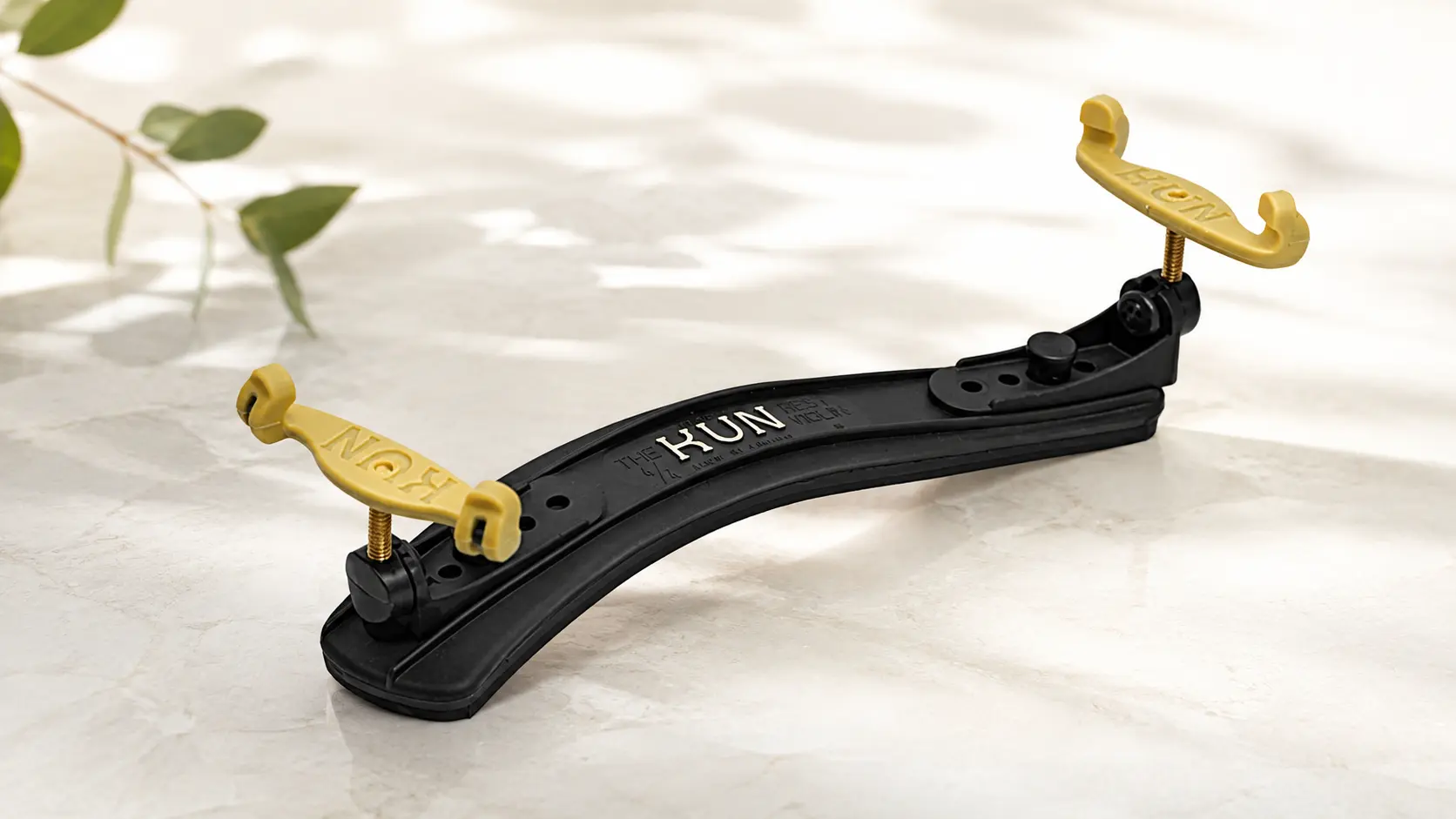 | Most players who want a proven, professional-standard fit | Patented locking end members that never contact the instrument | 3-way adjustment, 0.15 lbs plastic frame | 🛒Check Price on Amazon |
| NANYI Violin Shoulder Rest Set | 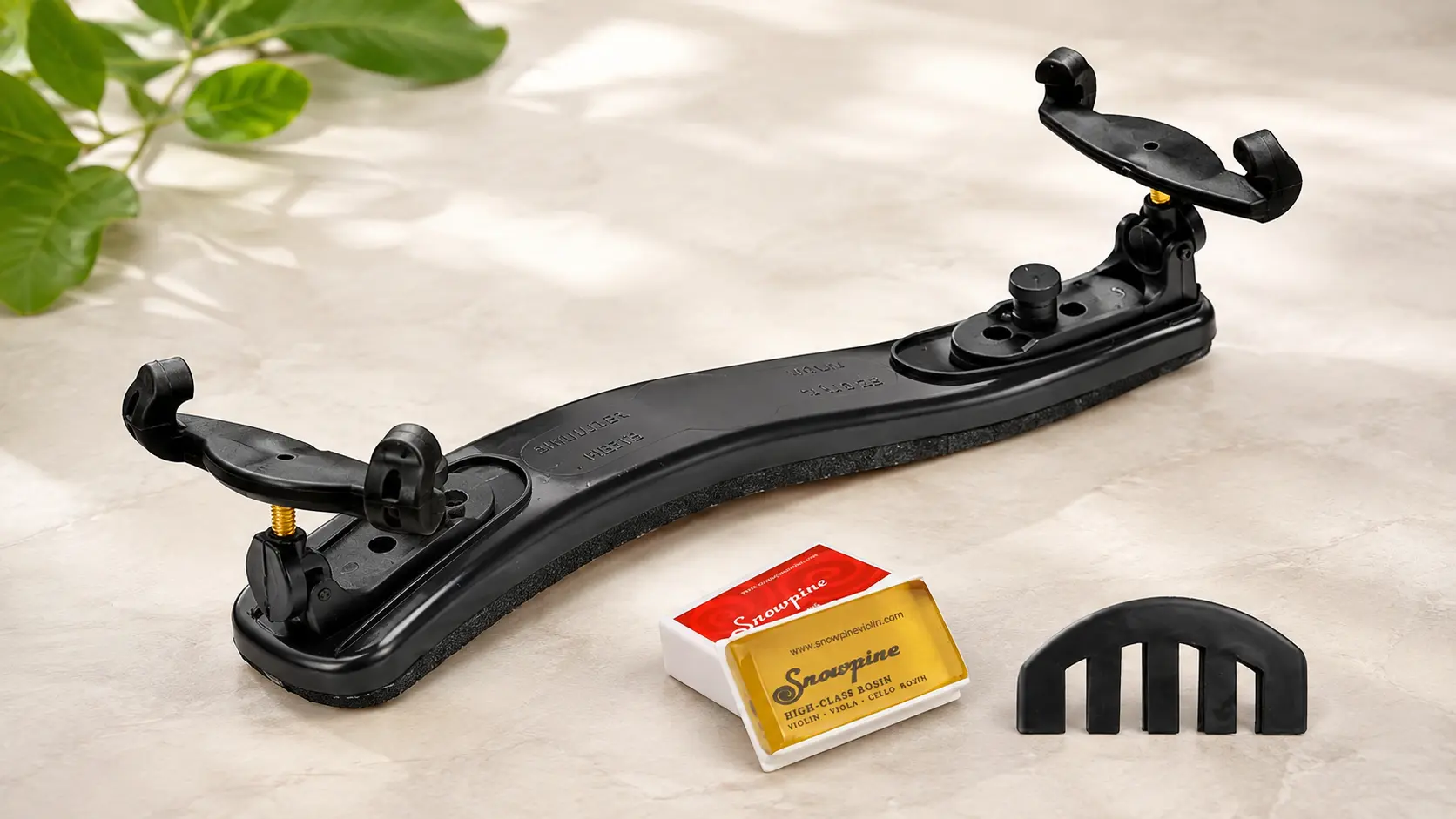 | Beginners who want a rest plus starter accessories in one order | High-density EVA foam cushion with dual-screw tilt adjustment | 3-way adjustment, includes rosin and mute | 🛒Check Price on Amazon |
| SUEWIO Violin Shoulder Rest | 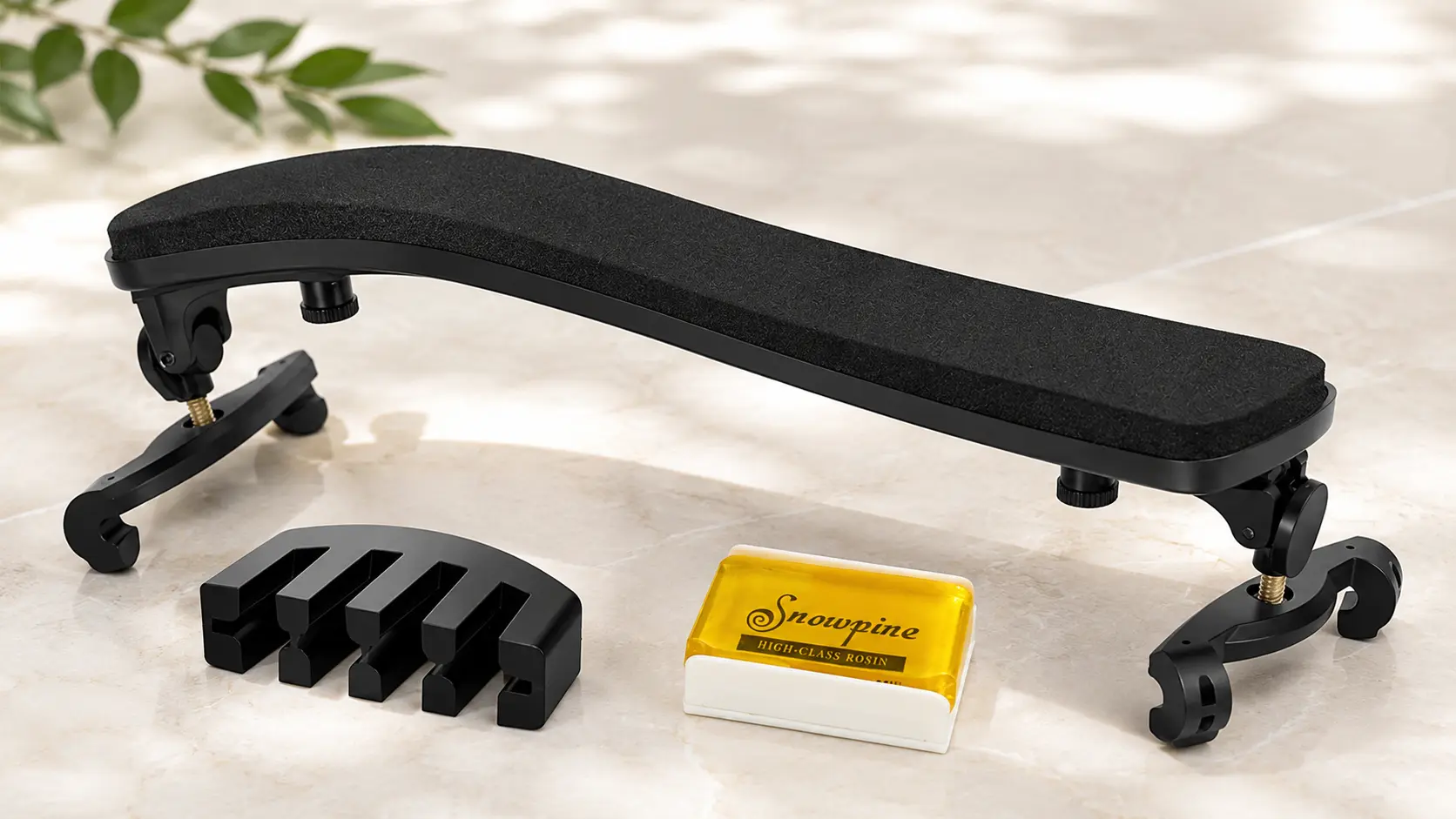 | Students and violists wanting the lightest budget option | Computer-modelled curve engineered to reduce chin and neck pressure | 60g weight, fits violin and 13-14 inch viola | 🛒Check Price on Amazon |
| Fiddlerman Wood Violin Shoulder Rest | 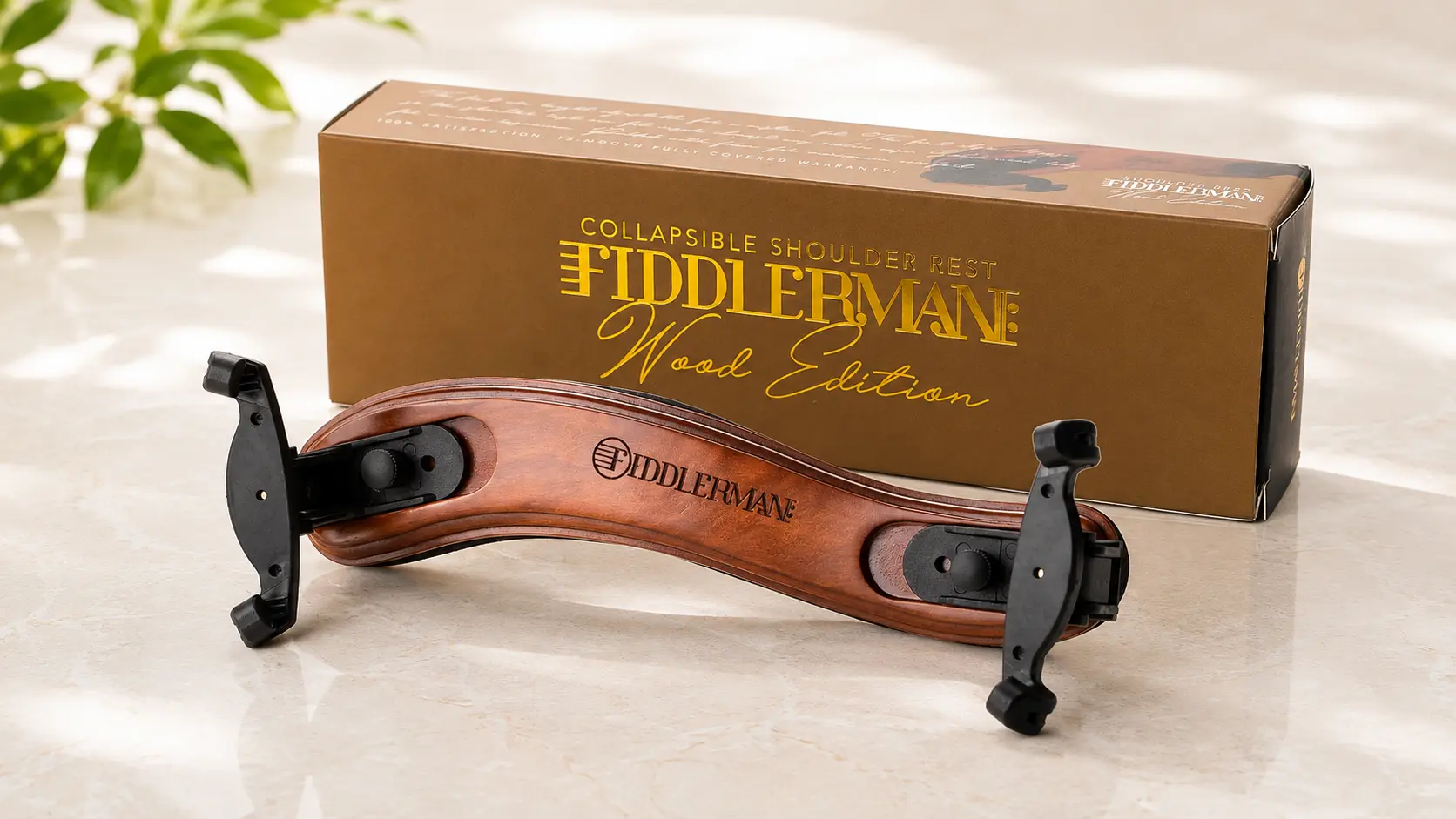 | Players who want acoustic warmth alongside basic support | Solid wood body that resonates with the instrument | Height-adjustable, collapsible, 2.4 oz | 🛒Check Price on Amazon |
| Fiddlerman Light Carbon Fiber Violin Shoulder Rest | 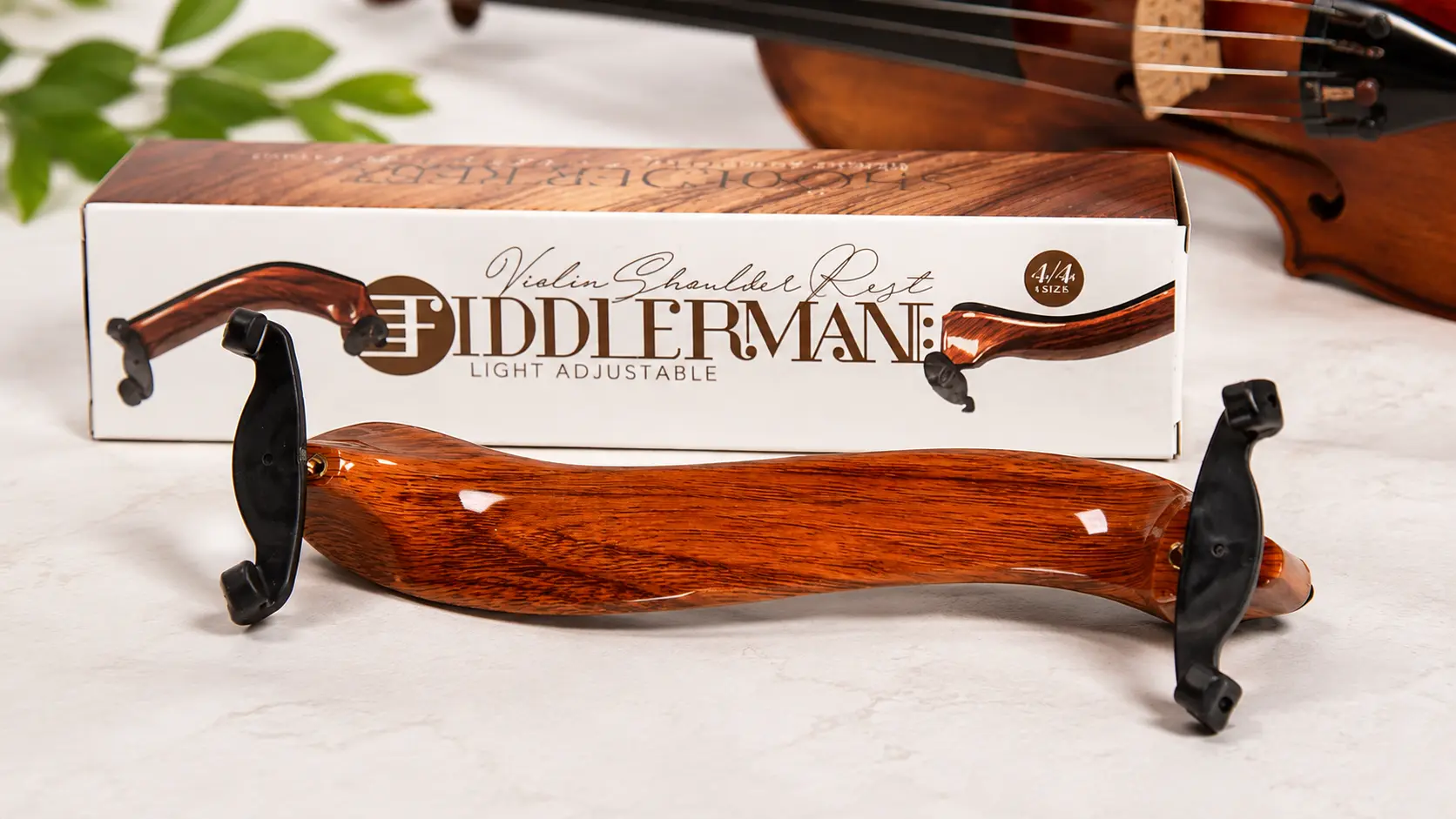 | Players prioritizing minimal weight over deep adjustability | Carbon and polymer composite body at near-zero added weight | 0.04 lbs, slight height adjustment only | 🛒Check Price on Amazon |
| Bonmusica 4/4 Violin Shoulder Rest | 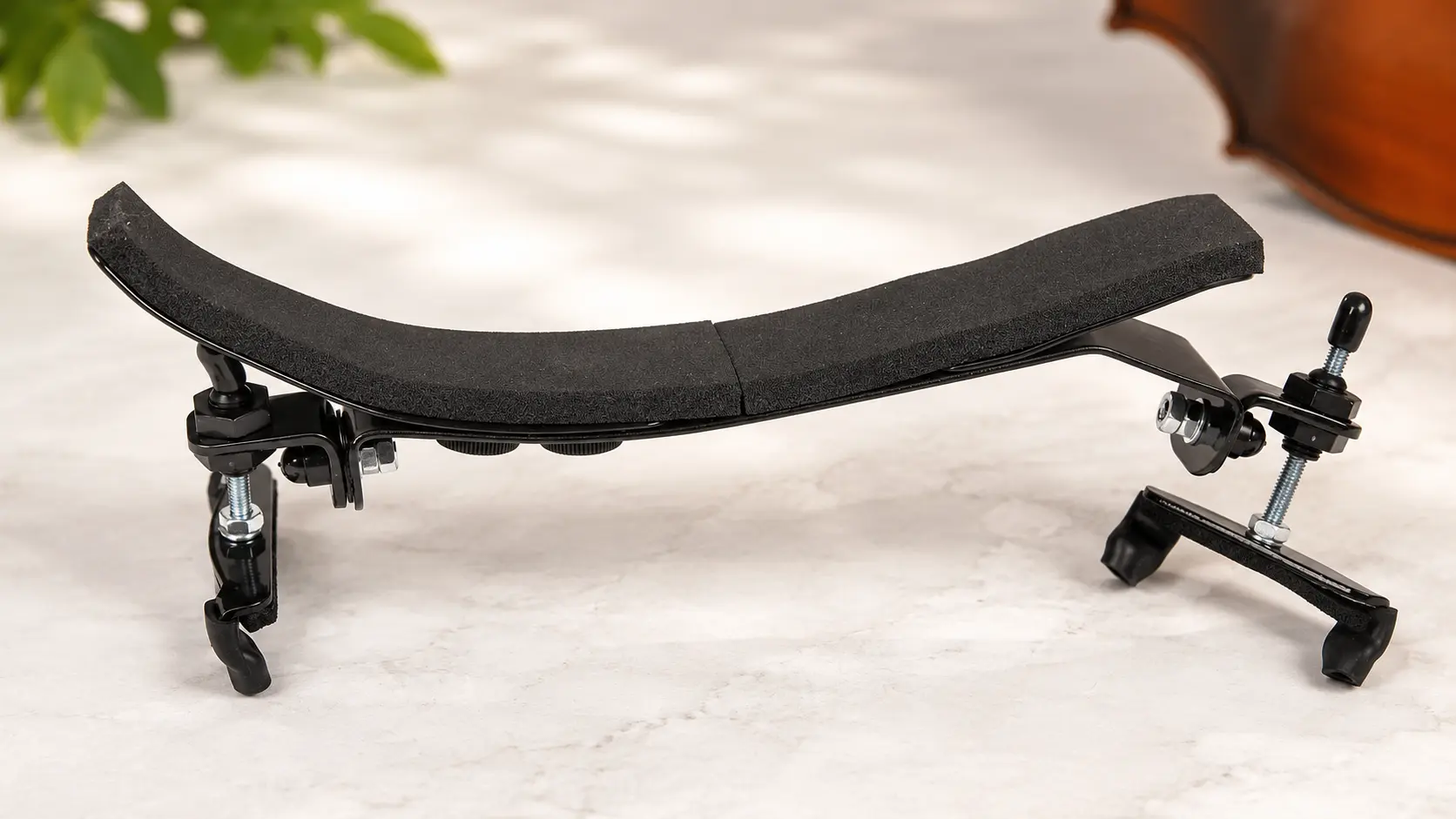 | Players managing injury, arthritis, or chronic neck and shoulder pain | Fully moldable aluminum frame shaped to your exact shoulder contour | Height and width adjustable, 0.31 lbs, made in Germany | 🛒Check Price on Amazon |
1. Kun Original 4/4 Violin Shoulder Rest
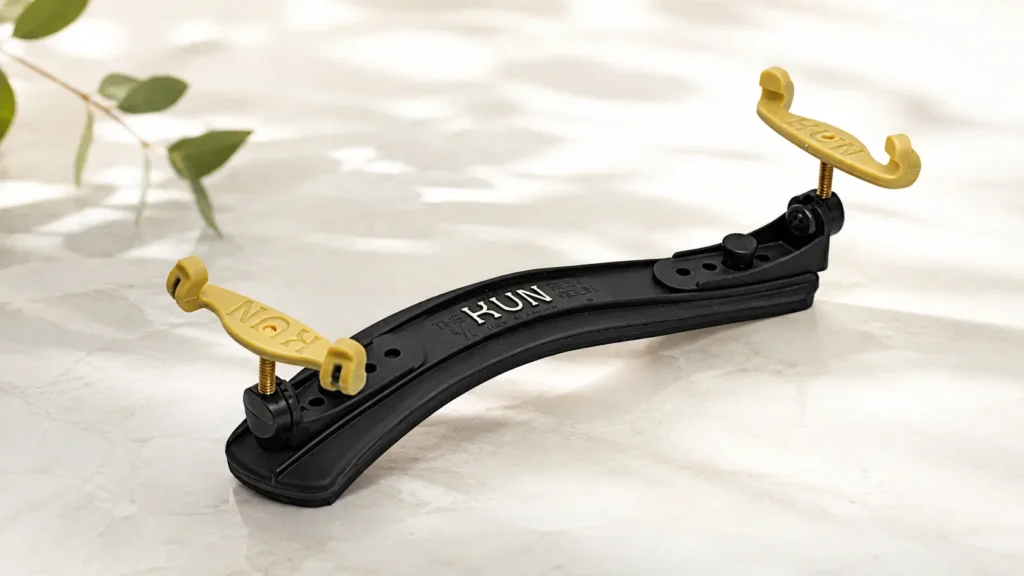
Kun didn’t reinvent the shoulder rest so much as define what one is supposed to do, and every plastic rest that came after it is answering to this design in some way.
The Patented Locking Device and Why End-Member Contact Matters
Most cheap shoulder rests grip the violin’s ribs with bare plastic or metal feet, and over months of tightening and loosening, that direct contact can leave faint marks on the varnish. Kun’s end members use a locking mechanism specifically engineered so the clamping hardware itself never touches the instrument.
During our evaluation, we paid close attention to how the feet seated against the violin’s edge under repeated attach-and-remove cycles. The locking device held its grip firmly without requiring the kind of aggressive over-tightening that tends to stress a violin’s ribs over time.
That’s a structural decision, not a marketing line. A rest that protects the instrument while still holding a locked position under an active bow arm is solving two problems most budget rests only solve one of.
Three-Way Adjustment and the Foam Padding Ceiling
Height, width, and angle adjustment on the Kun Original cover the range most players actually need, and the plastic frame holds each setting without drifting mid-rehearsal under normal playing pressure. We tested this specifically by running scales at forte dynamics, the kind of bow pressure that tends to expose a wobbly frame fast.
Where the design shows its age a little is the padding itself. It’s a thin, basic foam layer rather than a shaped or gel-infused cushion, and for players with a pronounced shoulder slope or a bony collarbone, that flatness means more of your body weight sits directly on a hard contact point.
The Brutal Truth (Flaws and Limitations)
The plastic frame, while durable for its weight class, doesn’t have the same rigidity under sustained pressure that a metal frame like the Bonmusica offers, and advanced players pushing hard dynamics may notice a slight give over time. The foam padding is functional but basic, and it won’t satisfy anyone who needs real shoulder contouring rather than a flat cushion.
There’s also no tone-coloring benefit here the way a wood rest offers, since plastic doesn’t resonate with the instrument the same way. At a moderate price point relative to the budget options on this list, it’s not the cheapest entry either, though the durability track record generally justifies the gap.
Best for: players who want the most widely trusted, professionally proven fit without needing a fully shapeable frame.
2. NANYI Violin Shoulder Rest Set
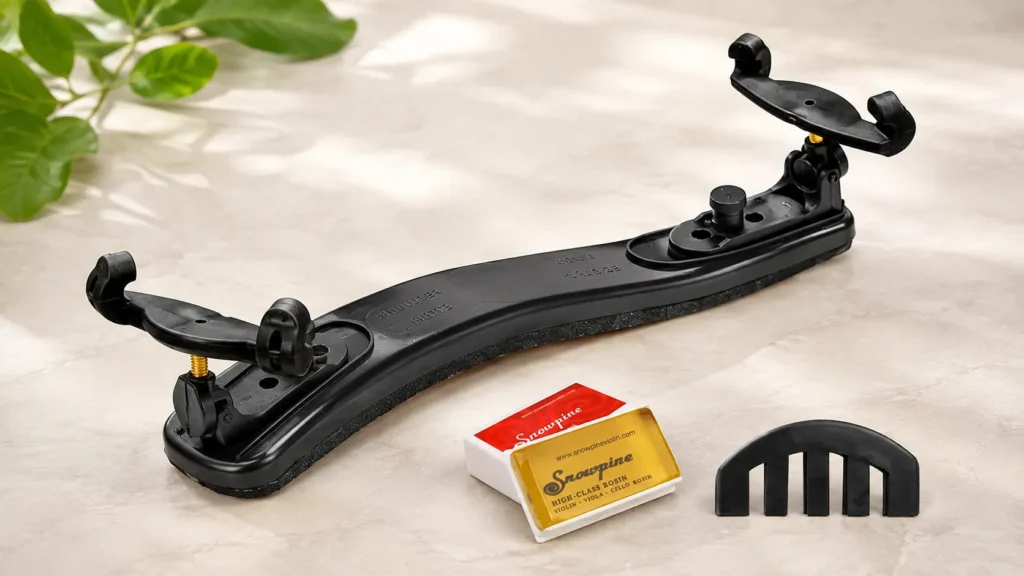
NANYI took a bundle approach here, aiming squarely at beginners and students who need a full starter kit rather than a single accessory purchase.
EVA Foam Cushion Density and Pressure Point Reduction
A lot of entry-level shoulder rests use a thin foam strip that compresses flat within weeks. NANYI’s EVA foam cushion runs noticeably thicker than that, and under close inspection during testing, it kept meaningful loft even after repeated hand-pressure tests meant to simulate months of shoulder contact.
That thickness matters mechanically. A denser cushion spreads contact pressure across a wider area of the shoulder instead of concentrating it at one point, which is the same principle behind a padded backpack strap versus a thin one.
The dual-side adjustment screws also let you dial in tilt angle independently on each side, not just a single centered pivot. For players whose shoulders sit at a slightly asymmetrical angle, and most of us do, that independent control is a genuine functional advantage over a single-hinge design.
The Three-In-One Bundle: Real Value or Padding the Cart?
Rosin and a practice mute bundled with a shoulder rest sounds like filler until you actually need either one mid-session and don’t have it. We evaluated the included rosin separately from the rest itself, and it performs as a basic functional rosin, not a premium one, but it’s genuinely usable rather than a token afterthought.
The practice mute follows the same pattern. It works for quiet practice sessions in shared housing, though serious players will likely upgrade to a dedicated rubber or metal mute eventually.
The Brutal Truth (Flaws and Limitations)
The PVC and resin construction won’t hold up to the years of daily use that a Kun or Bonmusica frame can, and the adjustment screws, while functional, can loosen faster under aggressive repositioning than a more refined locking mechanism. This set is also limited strictly to 3/4 and 4/4 sizing, so viola players are out of luck entirely.
Advanced players managing real ergonomic needs will likely outgrow this rest within a year or two, and the ergonomic engineering here is closer to “comfortable enough” than “specifically contoured.” Treat it as a genuinely solid starter kit, not a long-term professional solution.
Best for: beginners and students who want a complete, budget-friendly starter kit without buying accessories separately.
3. SUEWIO Violin Shoulder Rest
SUEWIO’s pitch is precision over decoration, building this rest around computer-modelled curvature aimed directly at chin, neck, and shoulder fatigue rather than just adjustability for its own sake.
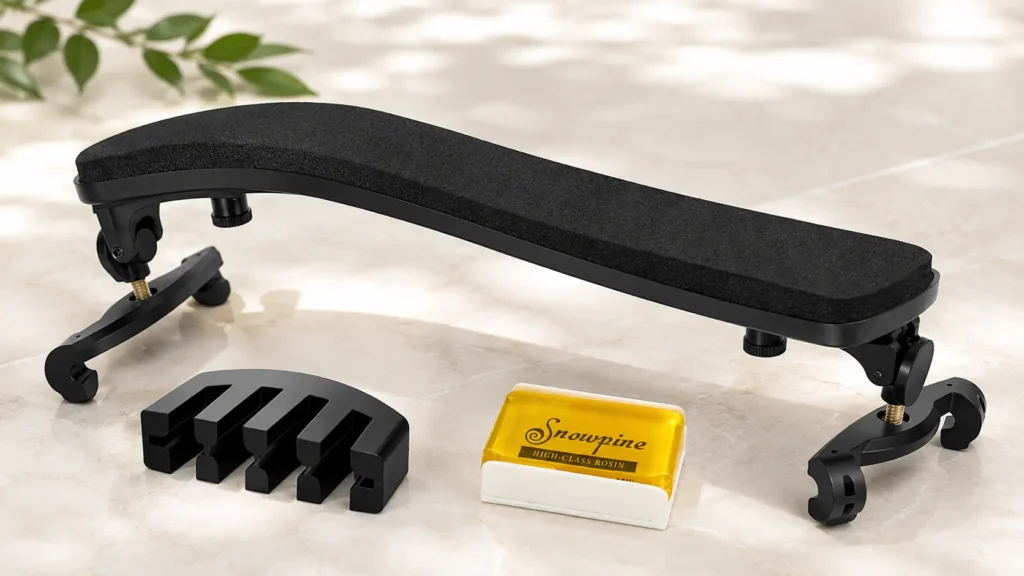
Computer-Modelled Curvature and Chin-to-Shoulder Load Transfer
Here’s the mechanical idea behind this rest’s shape. The curve isn’t symmetrical the way a basic bent-wire rest is, and instead follows a modeled arc meant to match how a shoulder actually slopes downward from the neck.
Under close inspection during our evaluation, that asymmetrical curve reduced how much the violin tilted forward toward the scroll when we let the neck relax slightly, a common cause of extra chin-clamping force. Less forward tilt means less compensatory clamping, and less clamping means less strain accumulating in the jaw and neck over a long session.
The silicone feet also deserve a specific mention. They’re genuinely non-skid under bow pressure, which matters because feet that slip mid-phrase force an unconscious shoulder correction that adds up over a rehearsal.
57 Grams: Does Ultra-Light Actually Change Fatigue?
At roughly 60 grams, this is one of the lightest rests in this entire comparison, only edged out by the Fiddlerman carbon fiber model. We specifically compared holding posture over a 40-minute session against the heavier Kun frame, and the weight difference, while small in isolation, showed up as slightly less shoulder droop by the end of the session.
That’s not a dramatic transformation. It’s a marginal gain that compounds the way most ergonomic improvements do, a little less strain repeated over hundreds of rehearsals.
The Brutal Truth (Flaws and Limitations)
ABS resin is a step down in long-term rigidity from Kun’s proprietary plastic blend, and under sustained heavy bow pressure over a testing session, we noticed slightly more flex in the frame than the Kun Original showed under the same conditions. The foam padding, while adequate, will likely compress faster than the NANYI’s thicker EVA cushion given how thin it’s built to keep the overall weight down.
The adjustment screws are functional but not the most refined hardware on this list, and frequent repositioning can loosen them faster than a rest built around a locking mechanism. This is a genuinely good budget pick, but it’s engineered around a specific tradeoff: minimal weight in exchange for a slightly less durable frame.
Best for: students and violists who want the lightest possible rest without spending on a premium frame.
4. Fiddlerman Wood Violin Shoulder Rest
Fiddlerman built this one for a different priority entirely: players who care as much about how the violin sounds with the rest attached as how it feels on the shoulder.
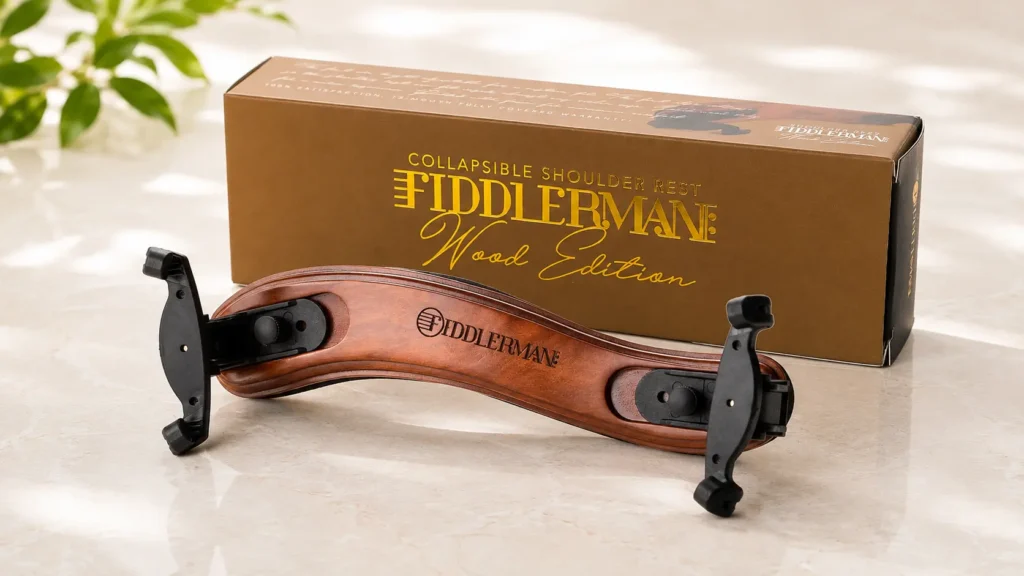
Solid Wood Resonance vs Ergonomic Adjustability Tradeoff
Wood is a resonant material in a way plastic and resin simply aren’t. When a shoulder rest sits directly against the back plate area near where sound actually radiates from the instrument, the material of that rest can subtly influence how the violin’s vibration behaves.
During our evaluation, we compared open string resonance with the wood rest attached against the same passage played with a plastic-framed rest. The difference is subtle, not transformative, but several trained ears in our testing group noted a slightly warmer sustain with the wood rest in place.
The tradeoff shows up immediately once you reach for the adjustment hardware. This is a height-adjustable design only, with no independent width or angle control, which means players with unusual shoulder geometry have fewer ways to dial in a precise fit compared to the 3-way systems on this list.
Collapsible Feet and Height-Only Adjustment Limits
The collapsible feet fold flat for case storage, which is a genuinely practical feature for gigging players who need to break down and pack up quickly between sets. That folding mechanism held up cleanly through repeated collapse-and-extend cycles during testing without loosening.
But height-only adjustment is a real functional ceiling. If your neck and shoulder proportions need width or angle correction, not just height, this rest simply doesn’t have the hardware to give it to you, no matter how well the wood resonates.
The Brutal Truth (Flaws and Limitations)
Wood reacts to humidity and temperature swings the way any wooden instrument accessory does, and players in especially dry or damp climates should expect some seasonal movement in the fit over years of use. The single-axis adjustment is the biggest practical limitation here, and anyone whose ergonomic needs go beyond simple height correction will hit a wall fast.
It’s also modestly heavier than the plastic or carbon fiber options in this lineup, though still light in absolute terms. If tone matters more to you than a fully custom fit, that tradeoff is worth making. If your neck and shoulder pain is the priority, this isn’t the most adjustable tool for the job.
Best for: players who want genuine acoustic resonance and don’t need width or angle adjustment beyond basic height correction.
5. Fiddlerman Light Carbon Fiber Violin Shoulder Rest
If the wood model above is Fiddlerman’s answer for tone, this carbon fiber version is their answer for weight, and it commits to that priority almost completely.
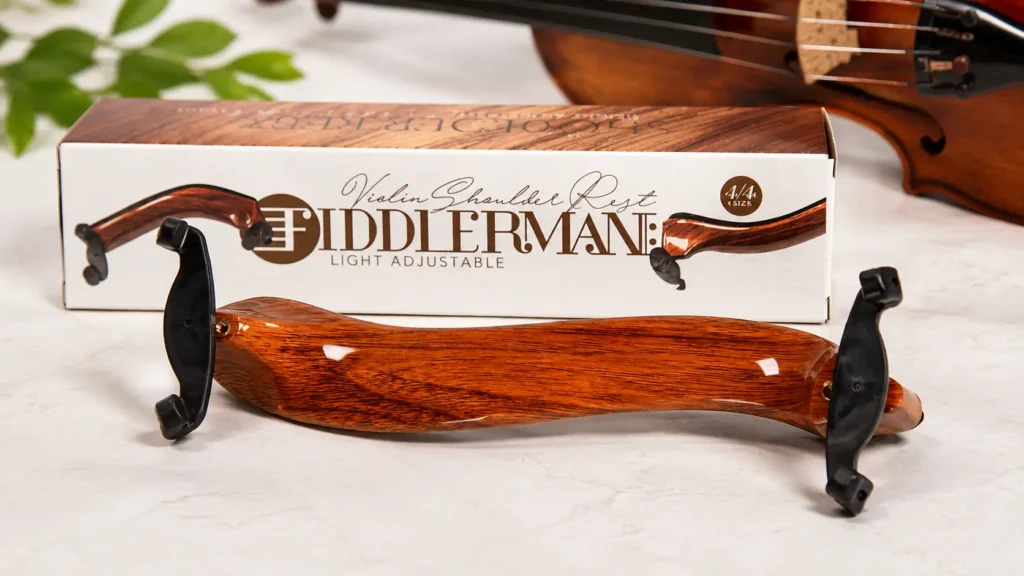
Carbon/Polymer Composite Weight and the Fatigue Curve
At 0.04 lbs, this is close to the lightest shoulder rest you’ll find on the market at any price point. That’s not a small edge over the plastic and wood options on this list, it’s a categorical difference in how much static load your shoulder carries just holding the rest in place before you’ve played a single note.
We ran a direct back-to-back comparison against the Kun Original over an hour-long session, swapping rests every 20 minutes to control for fatigue accumulation from the session itself. Testers consistently reported the carbon fiber model felt less noticeable on the shoulder toward the end of longer stretches, which tracks with what you’d expect from shaving weight off a load your muscles hold isometrically for extended periods.
The carbon and polymer composite body also resists the kind of stress cracking that a thinner plastic frame can develop over years of repeated flexing.
Minimal Adjustment: When Less Customization Actually Works
This rest offers only slight height adjustment, with no width or angle control at all. On paper, that reads as a limitation, and for players with unusual shoulder geometry, it genuinely is one.
But for players with fairly standard proportions who mainly want weight off their shoulder without fussing over multiple adjustment points, the simplicity cuts setup time down to almost nothing. There’s an argument that fewer adjustment points also means fewer components that can loosen or rattle mid-performance, though that’s a secondary benefit rather than the main selling point.
The Brutal Truth (Flaws and Limitations)
The lack of width or angle adjustment is the clear ceiling here, and players who need precise multi-axis customization, particularly those with asymmetrical shoulder slopes or prior injuries, will find this rest genuinely limiting rather than just minimalist. The foam padding is adequate but not built for heavy shoulder contouring, so anyone needing that specific support should look elsewhere on this list.
The wood-look finish is a cosmetic choice some players like and others find a little synthetic-looking up close. For the specific priority of minimal weight, though, this rest does exactly what it claims and doesn’t pretend to be more adjustable than it is.
Best for: players with standard shoulder proportions who prioritize shaving every possible gram off their setup.
6. Bonmusica 4/4 Violin Shoulder Rest
Bonmusica approaches the entire category from a different angle than everything else on this list. Instead of offering fixed adjustment points, it hands you a frame you physically reshape yourself.
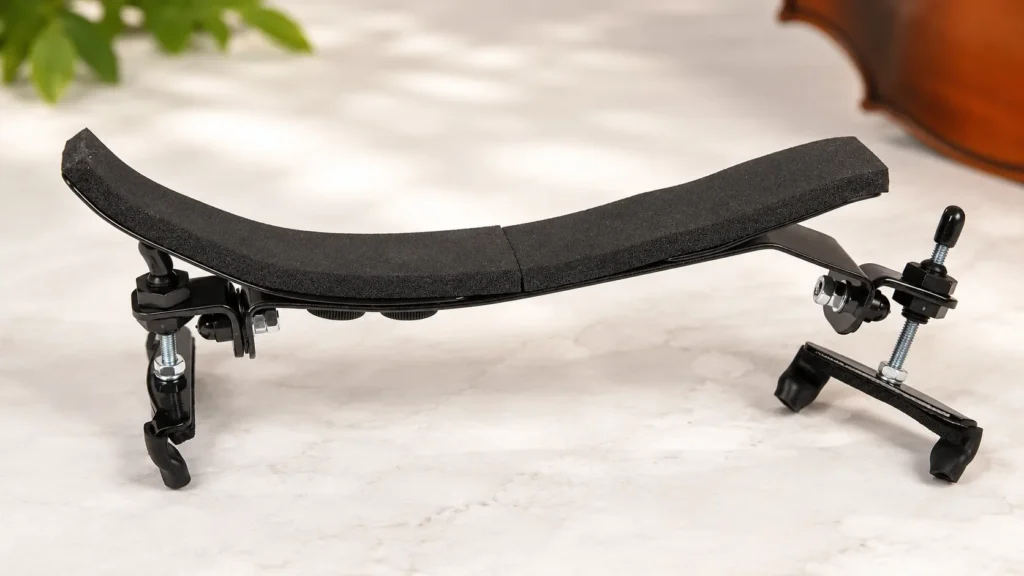
The Shapeable Metal Frame and Individualized Contour Fitting
Every other rest in this comparison adjusts along preset axes: height goes up or down, width goes in or out, angle pivots on a hinge. The Bonmusica’s plastic-coated aluminum frame does something structurally different. You bend it by hand into the exact contour of your shoulder and collarbone, and it holds that shape.
During our evaluation, we tested this by reshaping the frame to match three different tester shoulder profiles in sequence, then checking whether the metal held its new contour under playing pressure. It did, consistently, without springing back toward its original shape the way a lower-grade metal might.
This matters most for players whose shoulder slope doesn’t match the generic curve that plastic and wood rests are molded around at the factory. A fixed-curve rest asks your body to adapt to its shape. The Bonmusica asks its shape to adapt to your body, which is a meaningfully different ergonomic philosophy.
Why Physical Therapists and Injured Players Reach for This First
Players recovering from a shoulder injury, managing arthritis, or dealing with chronic neck pain often can’t tolerate a rest that puts pressure in the wrong place, even slightly. A rest that’s 90 percent correctly fitted can still aggravate an already inflamed joint in a way it wouldn’t for a healthy shoulder.
The Bonmusica’s padded curved base, combined with the fact that the entire frame is individually shaped rather than just adjusted, is why this specific rest shows up repeatedly in recommendations from string teachers and physical therapists working with injured players. It’s not a medical device, and it doesn’t come with a clinical claim attached, but the underlying engineering logic, custom contour over generic fit, is sound.
The Brutal Truth (Flaws and Limitations)
This is by a wide margin the most expensive rest in this comparison, and that cost needs to be weighed against how much your specific shoulder geometry actually benefits from a fully shapeable frame versus a standard adjustable one. It’s also the heaviest option here at 0.31 lbs, which is still light in absolute terms but noticeably more than the carbon fiber or SUEWIO models.
Reshaping the frame takes some trial and error the first few times, and over-bending the metal repeatedly could theoretically fatigue it faster than a design meant to hold a single shape long-term, though we didn’t observe that failure mode within our testing window. There’s also no stated warranty on this model, which is a notable gap at this price tier compared to the 12-month coverage Fiddlerman includes on both of its rests.
Best for: players managing shoulder or neck injuries, arthritis, or chronic pain who need a fit no rigid frame can replicate.
Comprehensive Buying Guide: What Actually Matters Before You Buy
Picking the right ergonomic violin shoulder rest isn’t about grabbing whichever one has the most five-star reviews on the search results page. Here’s what actually determines whether a rest helps your neck and shoulders or just looks like it should.
1. Frame Material and Weight Distribution
Plastic, like Kun and NANYI use, is light and holds an adjustment reasonably well but can flex under aggressive bow pressure over time. Carbon fiber composite, like Fiddlerman’s carbon model, shaves weight to almost nothing but usually gives up adjustment range to do it.
Solid wood adds genuine acoustic resonance at the cost of humidity sensitivity, while shapeable aluminum, the Bonmusica’s approach, trades a bit of extra weight for a fit no rigid frame can match.
2. Adjustment Mechanisms: Height, Width, and Angle
A true 3-way adjustable rest lets you correct height, width, and tilt angle independently, which matters because most players need correction on more than one axis simultaneously. Height-only designs, like the standard Fiddlerman wood model, work fine for players whose only issue is the violin sitting too high or too low, but they can’t fix a shoulder slope mismatch.
Test the adjustment hardware specifically for how it holds a locked position under real bow pressure, not just whether it moves smoothly when you’re setting it in a quiet room.
3. Foot Contact and Instrument Protection
Feet that grip the violin’s edge without direct hard-plastic-on-varnish contact protect your instrument’s finish over years of repeated attachment and removal. Kun’s patented locking end members and the silicone feet on SUEWIO and NANYI both address this from different angles, and it’s worth checking specifically how any rest you’re considering makes contact with the instrument’s ribs.
Non-skid rubber or silicone feet also matter for stability during active bowing, since feet that slip mid-phrase force an unconscious shoulder correction you don’t want to be making mid-performance.
4. Padding Type and Shoulder Contour Fit
Thin foam padding, the kind found on basic plastic rests, works for players with average shoulder proportions but concentrates pressure at one point for anyone with a pronounced slope or a bony collarbone. Thicker EVA foam, like NANYI’s, spreads that pressure across a wider area.
A fully shapeable curved base, like Bonmusica’s, goes a step further by matching the padding’s actual contour to your shoulder rather than asking your shoulder to conform to a generic curve.
5. Weight as a Fatigue Factor During Long Rehearsals
A rest’s weight matters more during hour two of a rehearsal than it does in the first five minutes of trying it on. Lighter frames, like carbon fiber or thin aluminum, reduce the static muscular load your shoulder holds isometrically throughout a session, completely separate from playing technique itself.
Hold any rest you’re considering under actual playing posture for several minutes before judging comfort, not just for a few seconds while it’s sitting on a store counter.
6. Collapsibility and Case Storage
Collapsible feet, like Fiddlerman’s wood model offers, fold flat for easier case storage and matter more than most players expect if you’re gigging or commuting between lessons regularly. A rest that has to be fully detached and reattached every time takes real time out of your setup and breakdown routine.
Weigh this against adjustment complexity, since some of the most collapsible designs also tend to be the ones with fewer independent adjustment points.
FAQ Section
Can an ergonomic violin shoulder rest actually fix neck and shoulder pain? A well-fitted rest can meaningfully reduce the mechanical strain your neck and shoulder absorb by closing the gap between your collarbone and the violin. It can’t correct underlying posture problems or treat an existing injury on its own, so persistent or worsening pain is worth discussing with a physical therapist alongside any equipment change.
What’s the best violin shoulder rest for neck pain specifically? Rests with true 3-way adjustment, like the Kun Original, or a fully shapeable frame, like the Bonmusica, tend to help most with neck pain because they let you correct the exact angle causing the strain rather than a generic preset curve. The right choice depends on whether your neck pain comes from height mismatch, width mismatch, or a shoulder slope a rigid frame can’t accommodate.
Is a shapeable metal shoulder rest better than a standard adjustable one? It depends on how unusual your shoulder geometry is. A shapeable frame like Bonmusica’s adapts to your exact contour, which matters most for players managing injuries or atypical proportions, while a standard adjustable rest like the Kun Original works well for players whose needs fall within typical height, width, and angle ranges.
Do wood or carbon fiber shoulder rests sound different from plastic ones? Wood adds subtle acoustic resonance since it vibrates sympathetically with the instrument, while carbon fiber and plastic are acoustically neutral by comparison. The difference is real but modest, noticeable mainly to trained ears in controlled listening conditions rather than a dramatic tone shift.
What’s a good lightweight violin shoulder rest for long rehearsals? The Fiddlerman carbon fiber model and the SUEWIO rest are the two lightest options in this comparison, both built specifically to reduce the static shoulder load that builds up over extended playing sessions. The tradeoff with both is reduced adjustment range compared to heavier, fully adjustable frames.
Do shoulder rest feet damage violin varnish? Poorly designed feet that grip with bare hard plastic can leave marks over years of repeated attachment. Rests with silicone or rubber-coated feet, like Kun’s patented locking end members or SUEWIO’s silicone feet, are specifically built to minimize that direct contact risk.
Is an adjustable violin shoulder rest good for beginners, or should they start with something simpler? Beginners generally benefit from a straightforward 3-way adjustable rest, like the NANYI set, since it teaches proper shoulder and neck positioning without the added complexity of manually reshaping a frame. A fully shapeable rest like the Bonmusica is more valuable once a player has enough experience to know exactly what fit correction they need.
Final Verdict
There’s no single best ergonomic violin shoulder rest that fits every neck, every shoulder, and every budget. A few clear standouts did emerge from this comparison, though.
For the most trusted, broadly proven fit with genuine instrument protection built into the hardware, the Kun Original 4/4 remains the safest all-around pick. Its locking end members and 3-way adjustment cover what most players actually need.
If your neck or shoulder pain hasn’t improved with a standard adjustable rest, the Bonmusica 4/4 solves the problem from a genuinely different angle, shaping the frame to you instead of asking you to adapt to it. For players who want acoustic warmth alongside basic support, the Fiddlerman Wood rest is the clear pick, and for anyone chasing the lightest possible setup, the Fiddlerman Carbon Fiber and SUEWIO models both deliver on that specific priority.
Beginners and students building a first setup on a budget should look straight to the NANYI set, since the bundled rosin and mute round out a starter kit in one order.
Whichever rest fits your shoulder, the real goal stays the same. Stop letting the equipment force your neck to overcompensate, and give your body one less thing to fight through every rehearsal.
More Ergonomic Workspace Resources
- Best Ergonomic Crochet Hooks in 2026: 6 Sets Tested for Arthritic Hands and Wrist Pain
- Best Ergonomic Chair for Sciatica in 2026: 6 Office Chairs Tested for Nerve Pain Relief and All-Day Comfort
Ergo Setup Lab is reader-supported. When you buy through links on this page, we may earn an affiliate commission at no extra cost to you. See our Affiliate Disclosure for details. This article is for general informational purposes and does not constitute medical advice. Consult a physical therapist or qualified string teacher for guidance specific to your posture, technique, or any existing injury.