
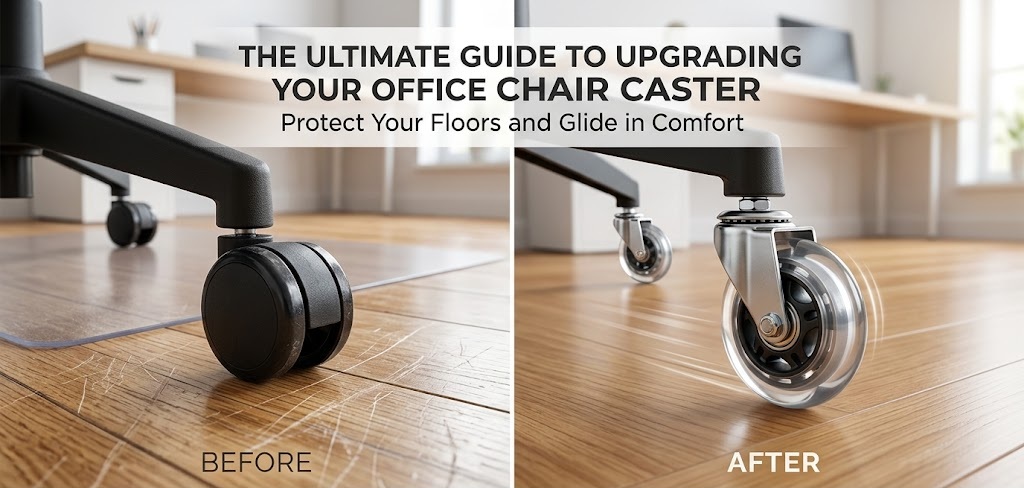
If you spend more than a few hours a day at your desk, you already know the importance of a well-designed workspace. You have probably invested in a highly supportive seat, a height-adjustable standing desk, and perhaps even an articulating monitor arm to keep your posture perfectly aligned. But there is one crucial mechanical component sitting right at the base of your setup that almost everyone ignores until it becomes a massive, expensive problem: the office chair caster.
Those standard, hard plastic wheels that come pre-installed on 99% of desk chairs are notorious workspace villains. They unapologetically scratch expensive hardwood floors, get hopelessly tangled in carpet fibers, and produce an annoying, grinding friction noise every time you shift your body weight. Worse still, their poor design forces you to buy ugly, cumbersome plastic floor mats that crack over time and completely ruin the visual aesthetic of your home office.
The good news? You do not need to buy a brand-new chair to fix this. A simple, five-minute procedural upgrade can completely transform your sitting experience. In this comprehensive, technical guide, we are going to dive deep into the anatomy of replacing your wheels, choosing the exact right materials for your flooring, and why upgrading your office chair caster might be the highest return-on-investment modification you make for your workspace this year.
The Anatomy of an Office Chair Caster
Before we talk about upgrading, let us establish what we are actually looking at from a structural standpoint. An office chair caster is not simply a piece of round plastic; it is the complete mechanical wheel assembly at the base of your chair. It is an engineered mechanism designed to swivel fluidly, support dynamic weight loads, and allow seamless mobility.
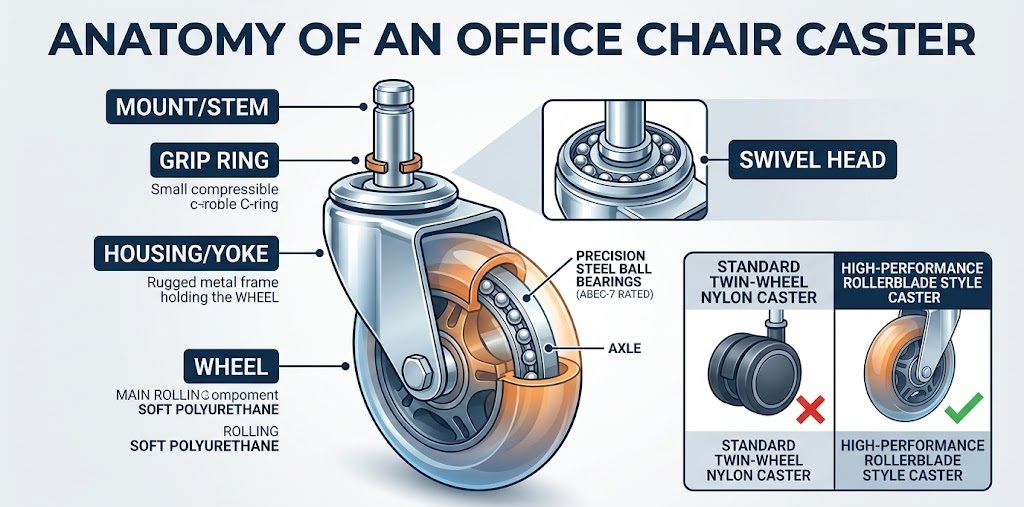
A standard caster consists of four main structural parts:
- The Mount/Stem: This is the metal pin that slides directly into the socket of your chair leg. It is the critical connection point bearing the vertical load.
- The Grip Ring: A small, compressible metal ring at the top of the stem that locks the wheel into the chair base using friction.
- The Housing/Yoke: The metal or thick plastic frame that holds the wheel axle in place and allows the entire unit to swivel 360 degrees.
- The Wheel: The actual rolling component that makes direct contact with your floor.
The widespread problem with factory-standard casters comes down to corporate cost-cutting. Chair manufacturers—even those producing high-end, thousand-dollar ergonomic chairs—often save money on the assembly line by equipping them with cheap, twin-wheel nylon plastic casters. These standard wheels are engineered to perform “adequately” on commercial, low-pile office carpets. However, they are completely mismatched for modern home offices featuring laminate, ceramic tile, pristine natural hardwood floors, or modern luxury vinyl plank (LVP).
The True Cost of Ignoring Your Casters: Why You Absolutely Need to Upgrade
If you are wondering whether spending a little time and money on a new set of wheels is worth the effort, the answer is a resounding yes. Swapping out your hardware is a game-changer for your daily workflow and your home’s structural integrity. Here is exactly why you need to make the change.
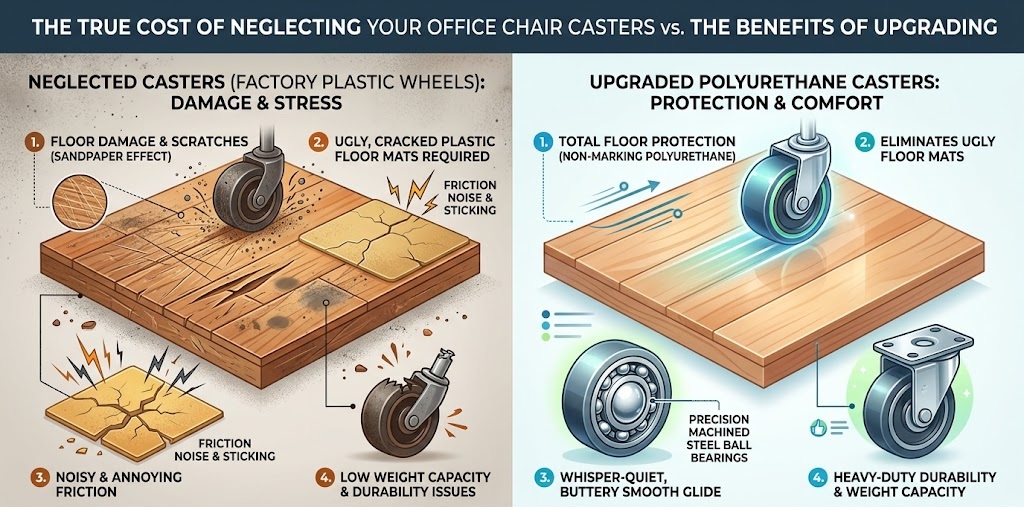
1. Total Floor Protection (Say Goodbye to Micro-Scratches)
Hard nylon plastic wheels act like dull sandpaper on hard surfaces. As you roll back and forth throughout the workday, the twin plastic wheels pick up microscopic pieces of dirt, sand, and ambient debris. Because the plastic is incredibly dense and hard, it does not absorb these abrasive particles. Instead, it traps them against the floor and grinds them directly into your hardwood or laminate finish. Over months, this leaves permanent scratches, deep gouges, and cloudy scuff marks.
Upgraded casters are typically made from soft, high-grade polyurethane. This rubber-like synthetic material is highly shock-absorbent and structurally safe for all hard surfaces. It glides smoothly without leaving residue or marks, acting as a crucial first line of defense in protecting your expensive wood floors from irreversible, long-term damage.
2. Eliminating the Dreaded Plastic Floor Mat
Polycarbonate and PVC plastic chair mats are universally disliked by interior designers and remote workers alike. They are expensive to replace, they constantly shift out of place requiring daily readjustment, their spiked bottoms can aggressively tear carpet backing, and they inevitably turn a sickly yellow and crack under pressure over time. Furthermore, they create an unattractive visual island in the middle of a carefully curated room. By installing a premium office chair caster, you can eliminate the need for a floor mat entirely. You gain the freedom to roll across your entire room without fear of damaging your floors.
3. Whisper-Quiet, Buttery Smooth Mechanics
Have you ever tried to push back from your desk, only to have the wheels seize up, forcing you to drag the heavy chair across the floor with a loud, disruptive screech? Standard twin wheels rely on cheap plastic friction points rather than actual bearings.
Premium replacement wheels, particularly rollerblade-style variants, utilize precision machined steel ball bearings (often rated ABEC-7 or higher) in both the wheel axle and the swivel stem. This sophisticated internal hardware allows for near-silent operation and buttery smooth, low-friction gliding. You will find yourself moving seamlessly from your primary monitor to your secondary filing cabinet with barely a push.
4. Heavy-Duty Weight Capacity and Durability
Standard plastic wheels are prone to cracking or snapping right at the stem base under heavy, repetitive loads. If you are a larger individual, or if you simply demand industrial-grade durability from your workspace equipment, upgraded wheels are the only logical choice. High-quality replacements feature solid steel brackets instead of plastic yokes, allowing a set of five wheels to routinely support combined weight capacities ranging from 500 lbs to over 650 lbs safely.
Understanding Your Caster Options: Which Type is Right for Your Workspace?
When you begin evaluating replacement hardware, you will notice a few distinct styles on the market. Understanding the material science and structural differences will help you make the exact right choice for your specific flooring environment.
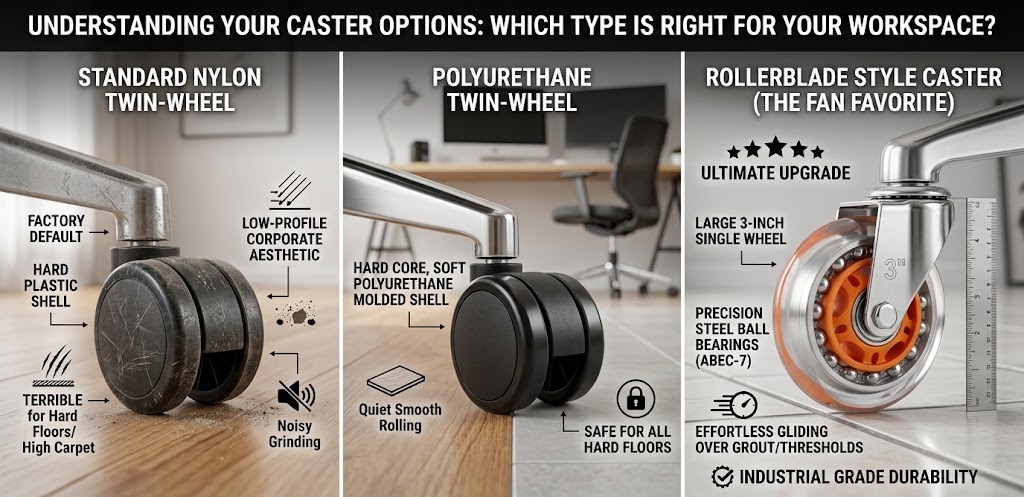
The Standard Nylon Twin-Wheel
This is the factory default you are actively trying to replace. They feature two hard plastic wheels sitting side-by-side on a single axle. While they offer acceptable performance for traditional, tightly woven commercial office carpet, they are structurally terrible for residential hard floors and high-pile carpets. Avoid replacing broken nylon wheels with more nylon wheels.
Polyurethane Twin-Wheel Casters
These look nearly identical to the standard wheels that came with your chair, making them visually unobtrusive. However, the hard inner core is wrapped in a thick, molded layer of soft, rubbery polyurethane. These are an excellent choice if you want to maintain the original, low-profile, corporate aesthetic of your desk chair while successfully gaining floor-safe, quiet rolling capabilities.
Rollerblade Style Casters (The Fan Favorite)
This is widely considered the ultimate upgrade for modern home offices and gaming setups. Visually, they look exactly like the wheels you would find on a premium pair of high-speed inline skates. They feature a single, large, transparent (or sleek black) polyurethane wheel housed inside a heavy-duty, polished steel bracket.
Because they have a significantly larger diameter (usually measuring exactly 3 inches, compared to the standard 2-inch plastic wheels), they possess the geometric advantage to roll effortlessly over deep tile grout lines, small doorway thresholds, and thick area rug borders with zero physical hesitation.
Ready to see the absolute best options currently on the market? If you are prepared to execute this upgrade and are looking for top-rated, stress-tested hardware, carefully review our comprehensive guide to the best office chair rollers replacement to pinpoint the perfect fit for your ergonomic configuration.
The Technical Measurement Protocol: Ensuring a Flawless Fit
One of the biggest hesitations people have regarding this upgrade is the fear of purchasing replacement hardware only to discover the stems do not fit their specific chair base. Fortunately, the furniture industry is highly standardized, but verifying your exact measurements is a mandatory technical procedure.
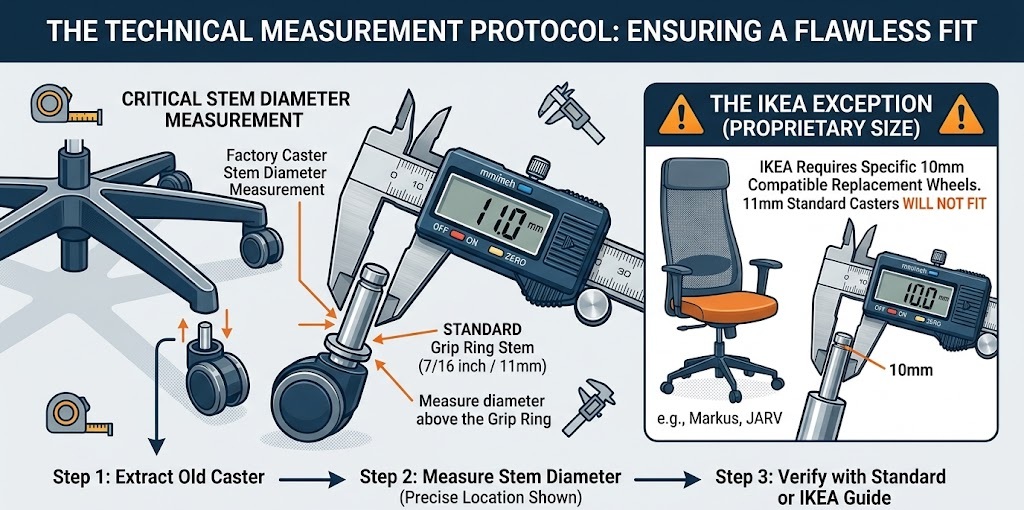
The single most critical measurement is the stem diameter.
Over 95% of all office chairs manufactured and sold in the USA utilize a universal “Grip Ring” mounting stem. This ubiquitous industry-standard stem measures exactly 7/16 inches (11mm) in diameter and 7/8 inches (22mm) in vertical length.
If your seating equipment is from a major manufacturer like Herman Miller, Steelcase, Autonomous, Secretlab, or essentially any standard office chair sourced from Amazon or big-box office supply retailers, a standard 11mm stem will seat perfectly.
The Singular Major Exception: IKEA Chairs. If your primary workspace chair is manufactured by IKEA (such as the widely used Markus, JÄRVFJÄLLET, or HATTEFJÄLL models), you must alter your hardware search. IKEA deliberately utilizes a proprietary, slightly smaller stem size measuring exactly 10mm (3/8 inches) in diameter. A standard 11mm office chair caster physically will not fit into an IKEA chair base. If you operate an IKEA chair, you must specifically source “10mm IKEA compatible” replacement wheels.
How to technically verify your stem thickness: If you want to be 100% certain before ordering, follow this verification step:
- Extract one of the existing factory wheels from your chair base (see removal instructions below).
- Take a set of digital calipers (preferred for accuracy) or a standard rigid measuring tape.
- Measure the exact width of the metal pin at the top above the grip ring. If it measures slightly under half an inch, you have the standard 7/16″ (11mm) stem.
Step-by-Step Guide: How to Execute the Wheel Replacement
Executing the replacement of your office chair caster is a straightforward, tool-free technical task that typically requires less than five minutes from start to finish. Follow these precise procedural instructions for a seamless assembly:
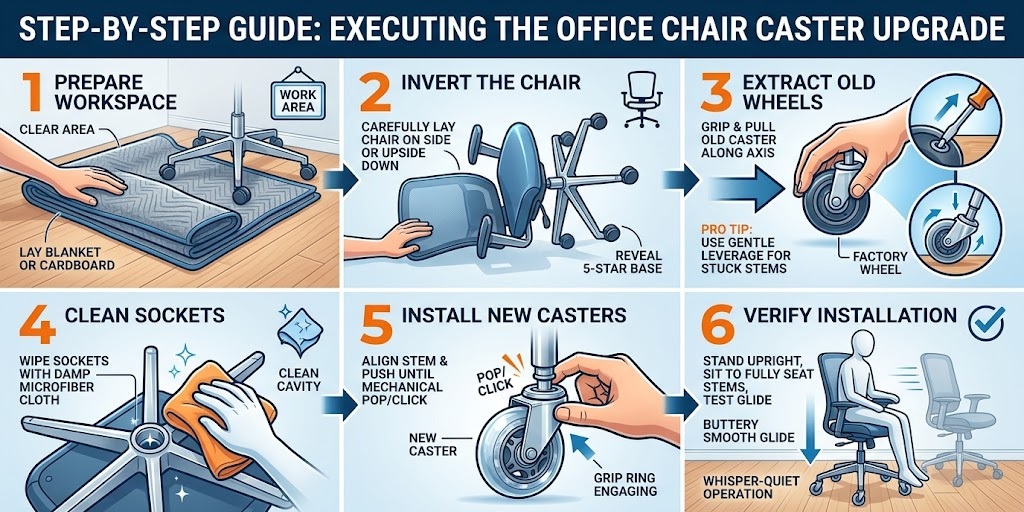
Step 1: Prepare the workspace. Clear an area on the floor. Lay down a clean towel, moving blanket, or a flattened piece of cardboard. This prevents accidentally scratching your desk chair’s armrests, leather, or mesh backrest when you lay the unit down.
Step 2: Invert the chair. Carefully lay your office chair on its side or completely upside down so the five-star base is fully exposed and safely accessible. Ensure the gas cylinder is not bearing any awkward lateral pressure.
Step 3: Extract the factory wheels. Grip the plastic housing of the old wheel firmly in your dominant hand. Pull straight up along the exact axis of the metal stem. The wheels are held in place solely by the friction of a compressible internal C-ring. Under normal conditions, they will quickly disengage with a firm, continuous tug. Pro Tip: If your chair is significantly older and the metal stem has oxidized or jammed, do not force it laterally. Take a standard flathead screwdriver, carefully slide the flat edge between the chair’s metal/plastic base and the caster housing, and apply gentle rotational leverage to smoothly pry the stem out of the socket.
Step 4: Clean the mounting sockets. Take a damp microfiber cloth and wipe out the interior of the metal sockets inside the chair legs. Over years of use, fine dust, floor wax, and pet hair can accumulate inside these cavities. A clean socket ensures the new grip ring seats perfectly.
Step 5: Install the new casters. Take your newly unboxed office chair caster and perfectly align the metal stem directly with the socket hole. Push firmly inward along the axis. You must push until you feel and hear a distinct, mechanical “pop” or “click.” This tactile feedback verifies that the internal grip ring has successfully compressed and expanded inside the base, locking the wheel securely in place. Repeat this exact protocol for all five legs.
Step 6: Verify the installation. Carefully lift the chair and stand it upright. Sit down slowly into the center of the seat to ensure all five metal stems are fully seated under load pressure. Finally, execute a test glide across your floor. You will immediately observe a massive difference in seat height, rolling speed, and acoustic silence.
Preventative Maintenance Tips for Long-Lasting Smoothness
Once you have successfully completed the installation protocol, you will want to keep your premium precision wheels performing at their peak technical capacity. While polyurethane rollerblade-style wheels require drastically less maintenance than standard twin plastic wheels, they still benefit from occasional attention.
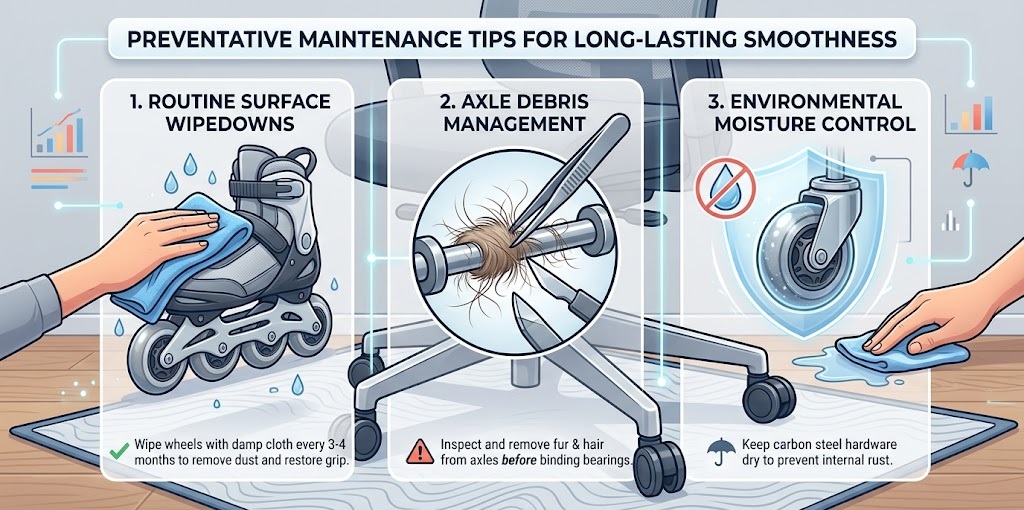
- Routine Surface Wipedowns: Every three to four months, take a lightly damp microfiber cloth and wipe the exterior surface of the polyurethane wheels. While they do not scratch floors, the soft rubber can gradually accumulate a thin layer of household dust that reduces their pristine grip.
- Axle Debris Management: Because these high-end wheels roll with such low friction, they can unfortunately act like magnets for pet fur, loose carpet threads, and long human hair. Inspect the horizontal steel axles periodically. If hair gets tightly wrapped around the axle shaft, do not let it build up. Use a pair of precision tweezers or a small utility knife to carefully cut the debris away before it migrates inward and tightly binds the internal steel ball bearings.
- Environmental Moisture Control: The heavy-duty brackets and internal bearings on premium casters are constructed from carbon steel. While they feature protective exterior coatings, introducing them to wet environments (like rolling through spilled liquids or utilizing the chair in a damp, unconditioned garage) can lead to moisture breaching the bearing seals, resulting in internal rust and catastrophic mechanical failure. Keep the hardware strictly dry.
Frequently Asked Questions (FAQs)
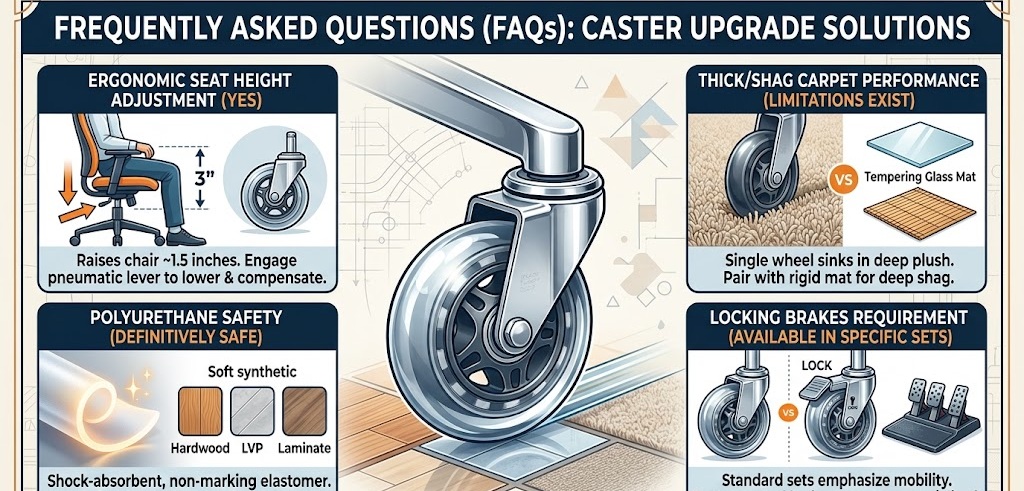
Will installing rollerblade casters noticeably alter my ergonomic seat height? Yes. Because rollerblade-style wheels possess a larger geometry (typically 3 inches in diameter compared to standard 2-inch plastic wheels), they will inevitably raise the overall baseline height of your chair by approximately 1 to 1.5 inches. For the vast majority of users, this provides a welcomed ergonomic boost, bringing them perfectly in line with standard 29-inch high desks. However, if your desk setup is exceptionally low, or if you have a shorter inseam, you will simply need to engage your chair’s pneumatic lever to lower the gas cylinder and compensate for the new wheel height.
Are polyurethane wheels definitively safe for engineered hardwood and LVP? Absolutely. Polyurethane is the exact same high-durability synthetic elastomer utilized in professional skateboard and inline skate wheels. It is inherently soft, highly shock-absorbent, and entirely non-marking. It is widely considered by flooring professionals to be the safest rolling material you can possibly utilize on luxury vinyl plank (LVP), delicate laminates, and soft engineered hardwoods.
Do premium upgraded wheels function effectively on thick, high-pile carpet? While 3-inch rollerblade wheels are an incredible mechanical upgrade for hard floors, low-pile commercial office carpets, and standard home carpets, extremely thick, plush residential carpets (like deep shag) can still present a physics challenge. Even with premium hardware, the narrow profile of a single wheel may sink deeply into the thick padding, requiring more physical effort to initiate a rolling motion. For exceptionally thick shag carpets, pairing your new wheels with a solid, high-grade tempered glass or rigid bamboo floor mat is still the most mechanically sound ergonomic solution.
Do these replacement casters feature locking brakes? Standard five-piece replacement sets generally do not feature integrated braking mechanisms, as the primary objective is achieving maximum unrestricted mobility. However, if you are operating your chair on a very smooth surface that has a slight gradient, or if you utilize racing simulator pedals where you specifically do not want to roll backward under pressure, you can easily source specific sets where two or three of the five wheels feature a manual, foot-operated locking brake tab to immobilize the setup.
The Bottom Line
Professionals routinely spend hundreds or even thousands of dollars optimizing their primary desks, calibrating multiple monitors, and perfecting their seated posture, yet they allow a neglected $30 piece of base hardware to actively ruin their floors and audibly disrupt their workflow.
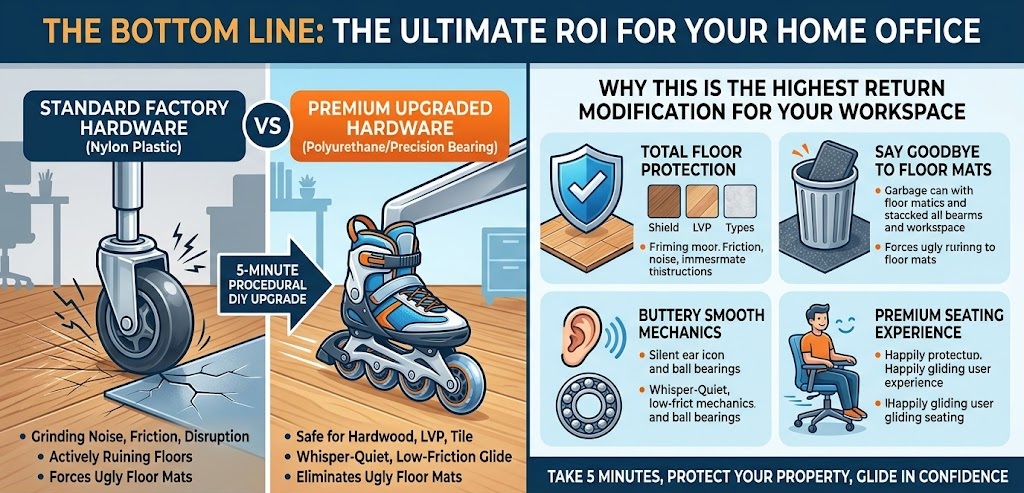
Executing an upgrade on your office chair caster is arguably the highest return-on-investment mechanical modification you can implement in your home office environment. By permanently swapping out the cheap factory plastics for high-grade polyurethane or precision-bearing rollerblade wheels, you instantly protect your property investments, officially ditch the unappealing plastic floor mats, and achieve a flawlessly smooth, utterly silent glide that transforms working at your desk into a genuinely premium experience.
Do not wait until you spot the first permanent scratch permanently etched into your floorboards. Take the required five minutes, meticulously follow the upgrade protocol, and enjoy a vastly superior ride.