

Whether you are a dedicated session musician laying down heavy grooves in the studio, a touring bassist rocking packed arenas, or a casual hobbyist jamming in your bedroom, the simple act of playing your instrument shouldn’t be a test of physical endurance. But if you are constantly rubbing a cramped thumb, shaking out a tired wrist, or struggling to maintain a steady grip on the fretboard during long sets, your traditional instruments are likely failing you. Just as an unsupportive desk chair can ruin your posture and cause lower back pain, a standard, heavily unbalanced instrument can wreak havoc on your hands, shoulders, and wrists over time. We firmly believe that making music should be a smooth, painless, and highly immersive process, not a source of chronic discomfort.
Swapping out those massive, shoulder-crushing instruments for a high-quality ergonomic bass guitar can completely revolutionize your playing experience. These specially designed instruments allow you to play longer, maintain better precision across the fretboard, and drastically alleviate physical strain. Whether you are hunting for a uniquely contoured body to help with a digging forearm or a fully headless design to eliminate neck dive entirely, investing in a premium ergonomic bass guitar is one of the smartest decisions you can make for your long-term comfort. This comprehensive guide will walk you through the science of hand fatigue, what features to look for, and the absolute best products currently trending on the market, complete with detailed specifications.
Understanding Ergonomics: Why an Ergonomic Bass Guitar Matters
Ergonomics focuses on designing products that align with the natural mechanics of the human body, reducing strain and increasing efficiency. When it comes to musical performance, ergonomics plays an invisible yet monumental role in ensuring that your hands, wrists, and fingers are supported correctly to foster creativity and high-level performances rather than pain. For working adults, touring musicians, and hobbyists, finding the right ergonomic bass guitar is incredibly vital due to the high volume of repetitive, high-tension motions we perform during practice and gigs. Standard, uniformly heavy wooden blocks simply fail to accommodate the natural resting state of the human body.
Most traditional basses designed decades ago feature a very bulky, unbalanced shape that requires immense shoulder strength and awkward wrist angling to control. This leaves musicians struggling to maintain a functional grip without cramping. An ergonomic alternative, like a well-crafted ergonomic bass guitar, prevents the common issues of slipping, muscle fatigue, and poor posture that arise from prolonged use of ill-fitting items. These specialized instruments are tailored to accommodate natural gripping patterns and body shapes, providing the necessary contours, weight relief, and perfectly balanced center of gravity to ensure the delicate tendons in your hands are perfectly aligned.
Furthermore, ergonomics isn’t merely about physical ease; it greatly enhances mental focus and cognitive endurance. When your body is comfortably supported by your chosen ergonomic bass guitar, you can focus on the complex rhythms you are executing rather than the distraction of localized pain. For those suffering from early signs of carpal tunnel syndrome or shoulder bursitis, highly specialized designs can literally give you your favorite passion back, allowing you to groove with dignity and ease. Therefore, prioritizing an ergonomic bass guitar can dramatically impact your daily musical workflow and overall quality of life.
The Pitfalls of Standard Instruments vs. an Ergonomic Bass Guitar
When musicians attempt to use standard, non-ergonomic options instead of an ergonomic bass guitar for hours on end—whether learning complex scales, tracking in the studio, or playing a three-hour gig—several mechanical failures and physical frustrations almost always occur. Understanding these pitfalls is the first step toward making a better purchasing decision.
- Neck Dive and Poor Balance: Traditional basses often have heavy headstocks. This causes “neck dive,” where the neck pulls toward the floor. You have to bear down incredibly hard just to hold the neck up with your fretting hand. This harsh force travels straight up from your knuckles, through your wrist, and into your shoulder, accelerating fatigue. A premium ergonomic bass guitar often uses a headless design to achieve perfect balance.
- Sharp Edges and Uncontoured Bodies: Standard instruments often lack proper forearm bevels and belly cuts. The user’s arm must rest against a sharp 90-degree angle to pluck or pick the strings. This restricts blood flow and causes nerve compression. A properly carved ergonomic bass guitar features deep body contours to stay comfortable, acting as an extension of your body rather than a burden.
- Excessive Weight: Traditional solid wood basses can weigh upwards of 10 to 12 pounds. During intense gigs without an ergonomic bass guitar, this massive weight sitting on a single shoulder strap contributes significantly to back soreness and spinal misalignment.
The Anatomy of Musician Fatigue: How an Ergonomic Bass Guitar Helps
To truly grasp why an upgrade is necessary, one must look at how bodily fatigue develops on an anatomical level while playing. The human hand consists of 27 bones, surrounded by an intricate web of ligaments, tendons, and muscles that are highly susceptible to repetitive strain injury (RSI). When you grip a rigid, heavy, unbalanced neck for hours, your intrinsic muscles remain in a state of continuous isometric contraction. They are firing constantly just to hold the instrument steady, before you even begin the kinetic movement of fretting notes.
By introducing an ergonomic bass guitar, you are actively accommodating the biological limits of your muscles. Instruments with multi-scale (fanned) frets, asymmetrical neck profiles, and chambered bodies allow the fingers to securely navigate the fretboard without demanding complex, exhausting muscle isolation. This provides a restful, empowering experience for your tendons. Instead of fighting against the instrument, the ergonomic bass guitar works in harmony with your natural biomechanics. The median nerve, which runs through the carpal tunnel in your wrist, is spared from being compressed due to the natural wrist angle encouraged by fanned frets and a raised instrument position, preventing numbness and tingling during long-haul studio sessions.
Key Features to Look for in a Quality Ergonomic Bass Guitar
When shopping for the ultimate ergonomic bass guitar to add to your musical arsenal, there are several key features to heavily evaluate. You need a tool that adapts to your specific playing style, hand size, and biomechanical needs.
- Headless Design: The most defining feature of a comfort-focused instrument is its weight distribution. Unlike generic basses, headless designs remove the heavy tuning pegs from the top of the neck, relocating them to the bridge. This gives the ergonomic bass guitar perfect balance, dramatically reducing shoulder and fretting-hand fatigue.
- Multi-Scale (Fanned) Frets: A true ergonomic bass guitar often features multi-scale frets. This means the lower strings have a longer scale length than the higher strings, naturally following the windshield-wiper motion of your arm. This prevents you from painfully pivoting your wrist at the lower frets, keeping your tendons properly aligned.
- Chambered or Lightweight Bodies: Comfort is also about how much weight you have to bear. Premium tools often feature chambered bodies—routing out internal wood to reduce mass. By removing physical weight, the ergonomic bass guitar hangs effortlessly on your strap, removing the burden of back and neck pain.
- Asymmetrical Neck Profiles: If you are investing in comfort, the neck shape must accommodate the natural curve of your hand. For users who want the ultimate playing experience, an asymmetrical neck (thicker on the bass side, thinner on the treble side) is an absolute necessity as it stabilizes your thumb and puts the fingers at the perfect anatomical curve.
Top 5 Recommendations: The Best Ergonomic Bass Guitar Models on the Market
Finding the right instrument offers the perfect blend of joy, aesthetics, and anatomical support. Here are our top 5 trending, highly-rated recommendations on Amazon when shopping for the best ergonomic bass guitar and most ergonomic guitar options on the market:
| Product Name | Product Image | Category | Main Feature | Buy Now |
| Ibanez Headless 6-String |  | Best 6-String Ergo | Multi-Scale Fretboard | [Buy on Amazon] |
| Ibanez Headless 5-String | 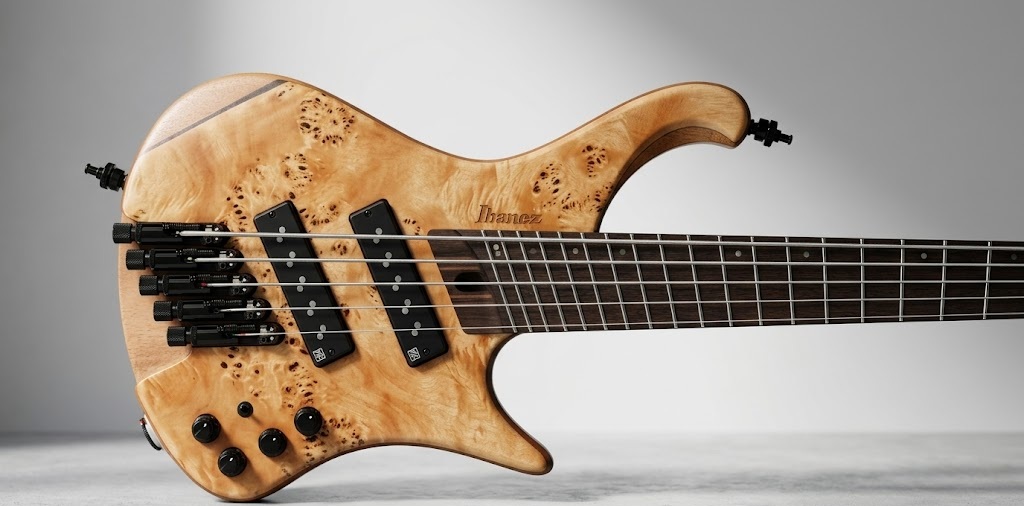 | Best 5-String Ergo | Headless Balance | [Buy on Amazon] |
| Ibanez Headless 4-String | 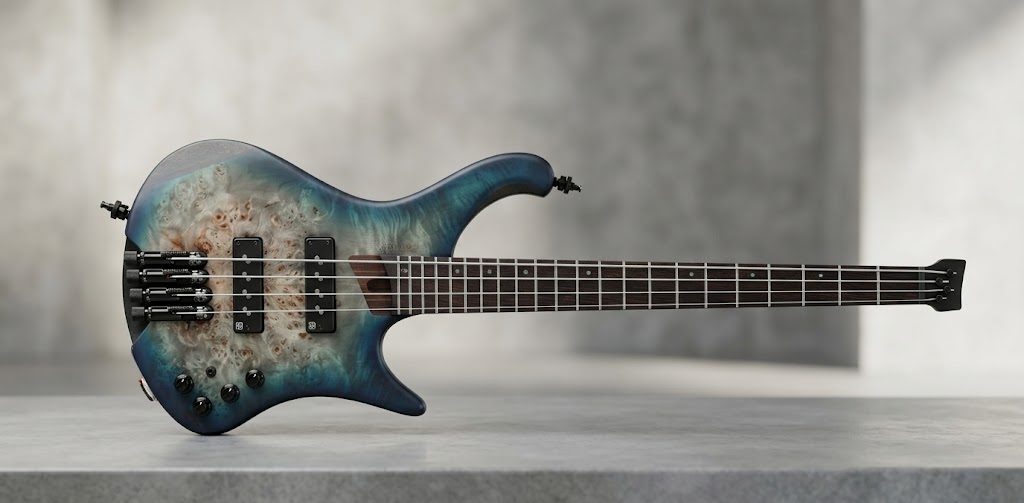 | Best 4-String Ergo | Slanted Body Contours | [Buy on Amazon] |
| Ibanez Headless 5-String (Alt) | 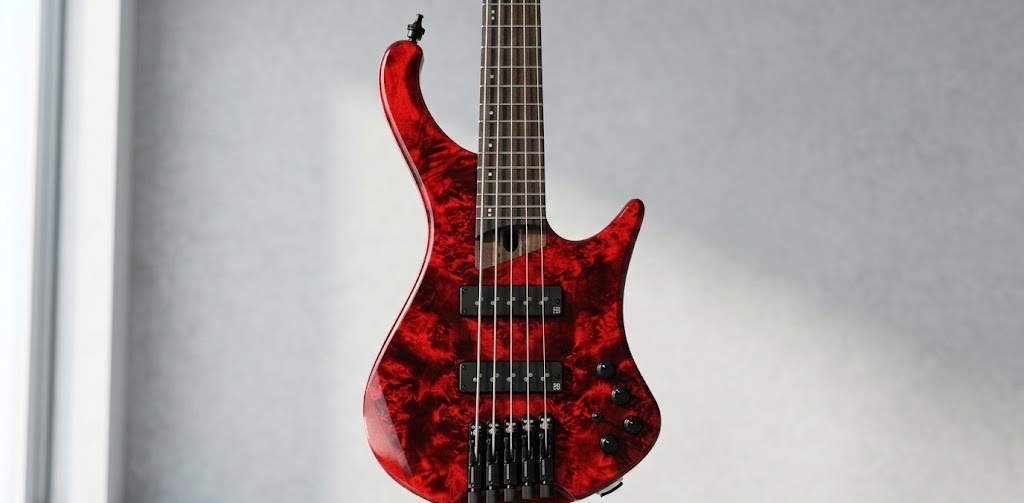 | Best Tone Variety | Custom Pickups | [Buy on Amazon] |
| Donner HUSH-X Kit | 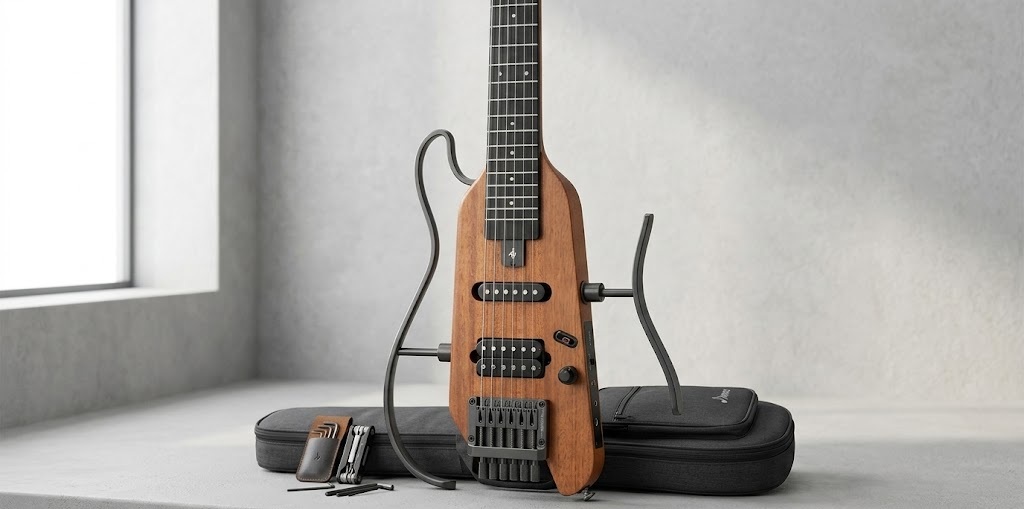 | Best Travel Ergo Guitar | Ultra-Light Frame | [Buy on Amazon] |
1. Ibanez Ergonomic Headless 6-String Electric
The Ibanez Ergonomic Headless 6-String Electric is a highly celebrated choice and is widely considered an incredible leap forward in modern instrument design. Its brilliant, user-friendly headless architecture perfectly aligns with what players expect from the most ergonomic guitar and bass cross-over designs, giving you extended range without the back-breaking weight.
| Feature | Details |
| Material | Lightweight body with custom neck |
| Strings | 6-String Extended Range |
| Design | Headless for perfect zero-gravity balance |
| Specialty | Deep forearm contours for blood flow |
Pros:
- A highly versatile ergonomic bass guitar/guitar crossover that sits perfectly on the lap.
- The headless design provides zero neck dive, saving your fretting shoulder.
- Deep cutaways allow for micro-adjustments and easy high-fret access without straining your fingers.
Cons:
- 6-string necks are naturally wider, which may take time for small hands to adjust to.
- Tuning at the bridge can require a learning curve for traditionalists.
2. Ibanez Ergonomic Headless 5-String Electric
When it comes to the standard modern low-end, this 5-string model is a powerhouse. It captures exactly why switching to an ergonomic bass guitar is so crucial for gigging musicians. By cutting out the bulky headstock and refining the body shape, Ibanez created a masterclass in comfort.
| Feature | Details |
| Material | Resonant, chambered wood |
| Strings | 5-String configuration |
| Design | Headless, ergonomic body molding |
| Specialty | Ideal string spacing for effortless slapping |
Pros:
- Acts as the ultimate ergonomic bass guitar for long 3-hour cover band gigs.
- Incredibly lightweight, meaning your back won’t ache the next morning.
- The low-B string remains tight and responsive without requiring a massive, heavy neck.
Cons:
- Proprietary strings or double-ball end strings are sometimes required.
- The modern aesthetic might not fit into a vintage-looking band setup.
3. Ibanez Ergonomic Headless 4-String Starburst
For the purist who loves the 4-string feel but desperately needs physical relief, the 4-String Starburst model is the pinnacle of the premium ergonomic bass guitar market. The sheer attention to detail in the body carving means it will naturally lock into your ribcage whether sitting or standing.
| Feature | Details |
| Material | Stunning Starburst finish over light woods |
| Strings | 4-String classic layout |
| Design | Headless with aggressive belly cut |
| Specialty | Slanted body angles for optimal wrist posture |
Pros:
- Unmatched comfort and a sleek feel that provides a genuinely immersive playing experience.
- Incredibly balanced center of gravity prevents any unwanted slipping, making it a perfectly stable ergonomic bass guitar.
- High-quality bridge tuners require the perfect amount of turning force.
Cons:
- Only 4 strings, so extended range players will need to look elsewhere.
- Premium finishes can be susceptible to belt-buckle rash if not careful.
4. Ibanez Ergonomic Headless 5-String Electric (Alternative Finish)
Another phenomenal entry in the 5-string category, this specific iteration offers unique tonal options while maintaining the strict standards of an ergonomic bass guitar. If you suffer from right-arm fatigue, the sloped edge of this body where your forearm rests will change your life.
| Feature | Details |
| Material | Selected lightweight tonewoods |
| Strings | 5-String |
| Design | Fully ergonomic, multi-dimensional curves |
| Specialty | Superior electronics with a lightweight footprint |
Pros:
- Serves as a top-tier ergonomic bass guitar for both studio tracking and live performance.
- The body sits intimately against the player, preventing you from reaching over the instrument awkwardly.
- Frictionless tuning mechanisms at the bridge.
Cons:
- The unique body shape may not fit standard rectangular hard cases.
- Requires a specialized gig bag (often included, but harder to replace).
5. Donner HUSH-X Electric Guitar Kit
While functioning as an electric guitar rather than a bass, the Donner HUSH-X easily earns the title of the most ergonomic guitar for travelers and minimalist musicians. Its frame-based design strips away everything unnecessary, leaving only the essential parts of the instrument to minimize weight to the extreme.
| Feature | Details |
| Material | Minimalist wood block with attachable metal frames |
| Strings | 6-String standard |
| Design | Headless, ultra-compact frame |
| Specialty | Perfect for practicing quietly on planes or in hotels |
Pros:
- Arguably the most ergonomic guitar for frequent travelers due to its easily disassembled frames.
- Weighs a fraction of a traditional instrument.
- Includes headphone outputs for silent, comfortable practice anywhere.
Cons:
- Lacks the full body resonance of a solid wood ergonomic bass guitar or standard guitar.
- The metal frames, while ergonomic, feel different than traditional wood contours.
Comparison of Popular Models: Finding Your Ideal Ergonomic Bass Guitar
Choosing between these phenomenal options comes down to identifying your specific pain points and musical requirements. If you are entirely new to headless instruments and suffer from general shoulder fatigue, the Ibanez 4-String Starburst offers the best introductory ergonomic bass guitar experience due to its familiar 4-string layout and highly forgiving body contours. Its lightweight nature makes it easy to move off your lap when you need to switch back to adjusting your amp or computer.
However, if you are an extended-range player, the choice is unequivocally the Ibanez Headless 5-String or 6-String. Attempting to play a massive 6-string with a traditional heavy headstock is a recipe for severe cramping and tendonitis. The ability to utilize the headless molding on this ergonomic bass guitar is a game-changer. Conversely, if you want a premium, customizable travel feel, the Donner HUSH-X acts as the most ergonomic guitar for life on the road. This is a massive anatomical benefit; if an instrument is too heavy to travel with, you simply won’t play it. Swapping to a lighter frame turns it into the perfect low-tension companion. Lastly, for pure technical death metal or jazz fusion enthusiasts who play complex chords, having an ergonomic bass guitar with perfect balance mimics the exact ergonomic posture needed for lightning-fast runs.
Health Benefits of an Ergonomic Bass Guitar for Joint Support
The health benefits of transitioning to a dedicated ergonomic bass guitar extend far beyond just your hands. When you use a proper, balanced instrument, you are forced to stand with your shoulders squared and open, rather than hunched over a heavy piece of wood pulling you to the left. This open chest posture improves breathing and reduces the strain on your upper back and cervical spine.
Furthermore, a high-quality ergonomic bass guitar mitigates the risk of De Quervain’s tenosynovitis—a painful condition affecting the tendons on the thumb side of your wrist. Because ergonomic designs place the neck at a natural 45-degree angle without requiring you to hold it up, you do not have to over-extend your wrist to reach the lower frets. By keeping the hand in a neutral, floating state, the fretboard is fully supported by the ergonomic bass guitar body balance. You make better harmonic choices, execute smoother slides, and ultimately enjoy the music on a much deeper level.
How to Properly Hold Your Ergonomic Bass Guitar
Purchasing the most ergonomic guitar or bass is only half the battle; how you hold it dictates its effectiveness. To get the maximum benefit out of your new ergonomic bass guitar, you must adjust your strap height so the instrument sits at the exact same height whether you are standing or sitting.
When sitting, do not rest the curve of the ergonomic bass guitar flat on your right leg (if right-handed). Instead, utilize the classical position by resting it between your legs on your left thigh, angling the neck upwards. This aligns your left wrist perfectly straight. Because an ergonomic bass guitar has no heavy headstock to pull it down, it will stay perfectly suspended at this optimal angle. Your right forearm should rest gently over the customized bevels, allowing your fingers to strike the strings without digging your forearm into a sharp wooden edge.
Deep Dive: The Science of Body Contours and Materials
Why does an ergonomic bass guitar look so different from a vintage 1960s model? It comes down to material science and biomechanics. Traditional basses used solid slabs of ash or alder, leading to a bulky, non-conforming block. An ergonomic bass guitar utilizes modern CNC routing to create “belly cuts” and “forearm contours.”
These contours act to increase the surface area of contact between the instrument and your body, distributing the pressure evenly. When you strap on the most ergonomic guitar designs, the instrument wraps around your ribcage rather than pushing against it. Furthermore, the use of roasted maple necks and chambered mahogany bodies in an ergonomic bass guitar removes moisture and unnecessary mass from the wood, resulting in a lighter, more resonant instrument that doesn’t sacrifice tone for comfort.
The Psychology of Musical Comfort
There is a powerful psychological component tied to using an ergonomic bass guitar. When you are in pain, your brain releases stress hormones that stifle creativity and slow down your reaction times. If you dread picking up your instrument because you know your shoulder will hurt in twenty minutes, you practice less, and your skills stagnate.
Investing in an ergonomic bass guitar shifts your mindset. The instrument becomes an inviting, comforting tool rather than an obstacle. Knowing you are holding the most ergonomic guitar available provides a placebo effect of confidence, but more importantly, a genuine physical release. This state of comfort allows you to enter a “flow state” much faster, where the instrument disappears, and only the music remains.
Maintaining and Caring for Your Ergonomic Bass Guitar
To ensure your ergonomic bass guitar continues to provide fluid, pain-free movement for years, regular maintenance is required. Sweat and dead skin can get trapped in the headless bridge tuners, creating physical friction. This friction forces you to pinch harder when tuning, negating the benefits of your ergonomic bass guitar.
Once a month, wipe down the strings and the bridge hardware of your ergonomic bass guitar with a dry microfiber cloth to remove skin oils that can degrade the metal. Use a soft brush to clean out the bridge saddles. If your ergonomic bass guitar has an unvarnished or oiled neck, a tiny application of specialized fretboard oil can keep the wood feeling factory-new, ensuring your hands never have to fight against sticky, dirty friction while sliding up and down the neck.
Hand Exercises for Bassists and Guitarists
Even with the absolute best ergonomic bass guitar, taking breaks and stretching is vital. Implementing a 5-minute stretching routine into your practice sessions will keep your tendons elastic and healthy.
- The Prayer Stretch: Place your palms together in front of your chest and slowly lower your hands until you feel a gentle stretch in your forearms. Hold for 30 seconds.
- The Reverse Prayer: Place the backs of your hands together in front of you and lower them. This counteracts the gripping motion you use on the neck of your ergonomic bass guitar.
- Finger Extensions: Wrap a rubber band around the outside of your fingers and gently spread them apart against the resistance. This builds the opposing muscles that are often neglected during heavy plucking.
Essential Accessories to Pair with Your Setup
Your musical rig should work as a cohesive system to support your body. Consider pairing your new ergonomic bass guitar with the following upgrades to complete your ergonomic playing setup:
- Extra-Wide Padded Straps: A 3-inch or 4-inch wide neoprene strap distributes the minimal weight of your ergonomic bass guitar perfectly across your shoulder, completely eliminating pressure points.
- A Posture-Correcting Stool: Sitting correctly keeps your spine aligned, allowing the ergonomic bass guitar to sit naturally against your torso.
- Light Gauge Strings: By lowering the string tension, you remove the most stressful physical requirement from your fretting hand entirely, maximizing the benefits of the most ergonomic guitar setup.
Frequently Asked Questions (FAQs)
Q: Are ergonomic bass guitar options really worth the higher price tag? A: Absolutely. While a premium model might cost significantly more than a basic entry-level bass, the long-term reduction in hand pain, shoulder fatigue, and daily frustration makes an ergonomic bass guitar an incredibly high-ROI investment for your body.
Q: Can an ergonomic bass guitar genuinely help alleviate symptoms of Carpal Tunnel Syndrome? A: Yes. Multi-scale fanned frets, asymmetrical neck profiles, and the perfect balance of a headless design physically prevent the tight wrist bending and hard pushing that inflames the tendons. By keeping the hand in a more open, relaxed state, an ergonomic bass guitar offers significant relief.
Q: What makes these models the most ergonomic guitar or bass choices? A: The combination of extreme weight reduction, removal of the headstock (which stops neck dive), and deeply carved body contours. These features transform a block of wood into a medically sensible, highly playable instrument.
Q: Will it take a long time to get used to playing a headless ergonomic bass guitar? A: For traditional players moving from a standard bass, the transition to a full ergonomic bass guitar setup is usually very quick. It generally takes about three to five days of consistent practice for your brain to remap its visual cues to a headless neck and to adjust to the new, healthier posture.
Conclusion: Finding the Perfect Fit
Playing music should be a seamless, joyful translation of your emotions into the acoustic world, not a painful, exhausting chore that leaves you icing your wrist or massaging your shoulder at the end of a long gig. By deeply understanding the mechanics of hand fatigue and actively seeking out specialized instruments like a perfectly balanced headless design or a uniquely contoured ergonomic bass guitar, you can finally provide your hands with the respect, care, and comfort they deserve.
Exploring top-tier, highly rated models such as the Ibanez Headless series and the Donner HUSH-X kit gives you a fantastic, thoroughly vetted starting point. Whether you are seeking a standard 4-string or the most ergonomic guitar for travel, carefully comparing the features, body cuts, and weight distribution allows you to make an informed, confident decision based on your specific physical needs and musical preferences.
Remember, providing a supportive, properly aligned posture for your new ergonomic bass guitar is just as important as buying one. By setting up a proper, body-aligned strap height and allowing your hands to discover the fretboard naturally without forcing it, you create a personalized ecosystem that promotes musical immersion, technical efficiency, and healthy joint maintenance. Take the time to find a shape, weight, and neck profile that fits your hand perfectly. By doing so, you are making a profound, lasting investment in your health and your art.
Related Articles You May Love:
- Explore our guide on desk comfort: [Best Ergonomic Joystick Models]
- Improve your office writing experience: [The Best Ergo Pen for Wrist Strain]
1 thought on “The 5 Best Ergonomic Bass Guitar Models for Pain-Free Playing”